



What's Happening?
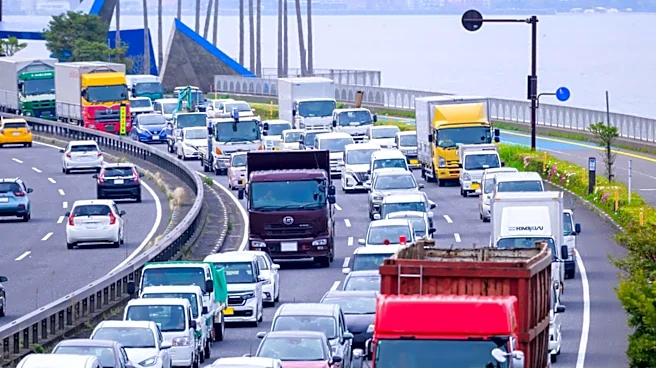
Palm Beach County is facing a significant increase in traffic congestion, prompting a new transportation master plan to recommend a long-term revenue source, potentially a sales tax, to fund necessary infrastructure improvements. The comprehensive plan,
exceeding 1,000 pages, highlights that without intervention, traffic congestion could surge by over 70% on some roads by 2050. Current bottlenecks already extend over two miles on major corridors, with peak travel speeds significantly below posted limits. The report identifies increasing east-west travel demand, gaps in public transit, and safety concerns for pedestrians and cyclists as primary drivers of the problem. Specific recommendations include enhancing bus services, upgrading traffic signals, and exploring a premium transit corridor along State Road 7 and Okeechobee Boulevard. The plan also advocates for intelligent transportation technologies, such as adaptive traffic signals and AI-driven management, and considers emerging solutions like robotaxis and drone delivery systems.
Why It's Important?
The proposed transportation tax and master plan are crucial for Palm Beach County's economic vitality and quality of life. Unchecked traffic congestion can deter businesses, reduce productivity, and negatively impact tourism, a key industry for the region. The plan's emphasis on a dedicated funding source, similar to approaches in neighboring Broward and Miami-Dade counties, aims to secure additional state and federal grants, demonstrating the county's commitment to addressing its infrastructure challenges. Investing in public transit, such as bus rapid transit and light rail, could alleviate pressure on roadways, offer residents more sustainable commuting options, and improve air quality. Furthermore, addressing pedestrian and cyclist safety concerns, particularly in high-accident corridors, is vital for public health and community well-being. The exploration of advanced technologies like autonomous vehicles signifies a forward-thinking approach to urban planning, potentially positioning Palm Beach County as a leader in smart city initiatives.
What's Next?
The transportation master plan is scheduled for presentation to Palm Beach County commissioners, who will decide whether to advance the plan. While the report does not specify a sales tax rate, it suggests commissioners consider various funding options, including sales taxes, tolls, congestion pricing, and tourism-related fees. If approved, the county would likely begin the process of establishing a dedicated transportation fund and reserve, which would be instrumental in attracting state and federal grants for major projects. Future steps would also involve closer collaboration with the private sector to leverage technology and innovation in transportation planning. The implementation of recommended projects, such as increased bus frequencies, upgraded traffic signals, and expanded pedestrian infrastructure, would follow, with a long-term vision extending through 2050 to manage the anticipated population growth and its impact on the region's transportation network.
Beyond the Headlines
The debate over a new transportation tax in Palm Beach County highlights a broader national challenge faced by rapidly growing urban and suburban areas: how to fund and manage infrastructure development in the face of increasing population and economic activity. The plan's recommendation for a dedicated revenue stream underscores a shift towards more sustainable and comprehensive funding models, moving away from solely relying on existing budgets. The emphasis on public-private partnerships and emerging technologies like autonomous vehicles suggests a recognition that traditional road expansion alone cannot solve modern congestion issues. This approach could set a precedent for other U.S. counties grappling with similar problems, encouraging integrated solutions that combine mass transit, smart technology, and land-use planning. The ethical considerations of potential sales taxes, which disproportionately affect lower-income residents, will likely be a key point of discussion, balancing the need for infrastructure investment with equitable financial burdens.