



What's Happening?
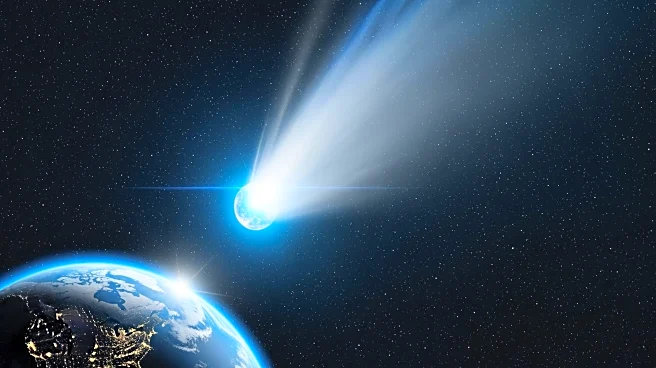
Interstellar comet 3I/ATLAS is set to make its closest approach to Earth on December 19, providing astronomers with a rare opportunity to study an object from outside our solar system. Detected on July 1 by the NASA-funded ATLAS survey telescopes in Chile,
3I/ATLAS is only the third confirmed interstellar object observed in the solar system, following 1I/‘Oumuamua in 2017 and 2I/Borisov in 2019. The comet will pass approximately 1.8 astronomical units from Earth, equivalent to about 168 million miles, posing no threat to the planet. Its size is estimated to be between 440 meters and 3.47 miles wide. As it moves away from the Sun, the comet is expected to become dimmer, complicating future observations.
Why It's Important?
The passage of 3I/ATLAS offers a unique chance for scientists to gather data on interstellar objects, which are rarely observed. These objects provide insights into the conditions and processes occurring in other star systems. Understanding their composition and trajectory can enhance knowledge about the formation and evolution of the solar system and the broader galaxy. The comet's journey through the solar system allows astronomers to refine their techniques for tracking and studying such objects, potentially improving future detection and analysis capabilities.
What's Next?
Following its closest approach to Earth, 3I/ATLAS will pass near Jupiter in March, coming within about 33 million miles of the gas giant. It will then continue its journey out of the solar system, expected to return to interstellar space by the mid-2030s. During this time, astronomers will continue to observe the comet using various telescopes, including the Hubble Space Telescope, to collect as much data as possible. These observations will contribute to a growing body of knowledge about interstellar objects and their characteristics.