







What's Happening?
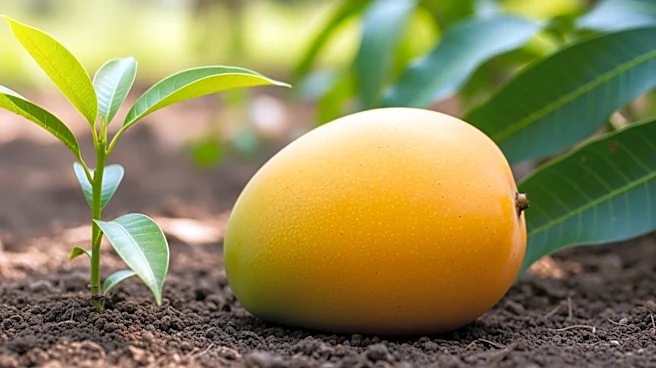
The State Horticulture Research Centre (SHRC) in Tripura has initiated trials of exotic mango varieties to achieve self-sufficiency in high-value mango production. The initiative, led by Agriculture and Farmers’ Welfare Minister Ratan Lal Nath, involves
assessing the adaptability and yield potential of several premium mango varieties under Tripura's agro-climatic conditions. The project aims to lay the groundwork for future expansion of quality planting materials. The SHRC is also focusing on the conservation and evaluation of indigenous germplasm, including Surji chilli and Bird’s Eye chilli, to preserve the state's agricultural heritage and support future crop improvement programs.
Why It's Important?
This initiative is significant for Tripura's agricultural sector as it seeks to enhance the state's self-reliance in mango production, reducing dependency on external sources. By cultivating high-value crops, the state can boost its agricultural economy and improve farmers' livelihoods. The conservation of indigenous germplasm also plays a crucial role in maintaining biodiversity and supporting sustainable agricultural practices. The project aligns with broader goals of agricultural innovation and economic development in the region.
What's Next?
The SHRC will continue to monitor the performance of the exotic mango varieties and expand the cultivation of other high-value crops like yellow-skinned watermelon. The state aims to achieve self-sufficiency in ware potato production by 2029-30, further strengthening its agricultural economy. Ongoing research and development efforts will focus on introducing new crop varieties and improving cultivation techniques to enhance productivity and profitability.