


What's Happening?
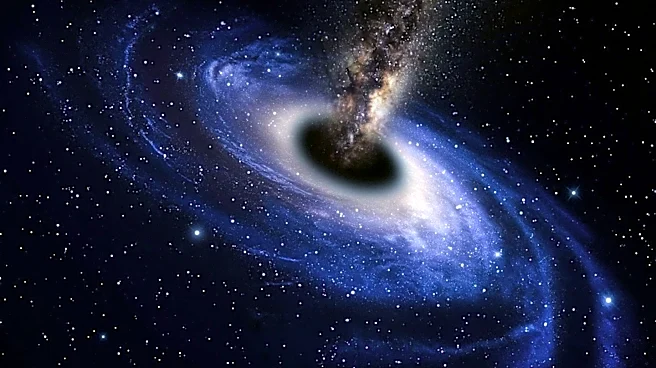
Astronomers are employing observations of impossibly fast-moving stars, such as S301, to study Sagittarius A*, the supermassive black hole at the center of the Milky Way. S301, traveling at over 8% of the speed of light, is the fastest-known member of a group
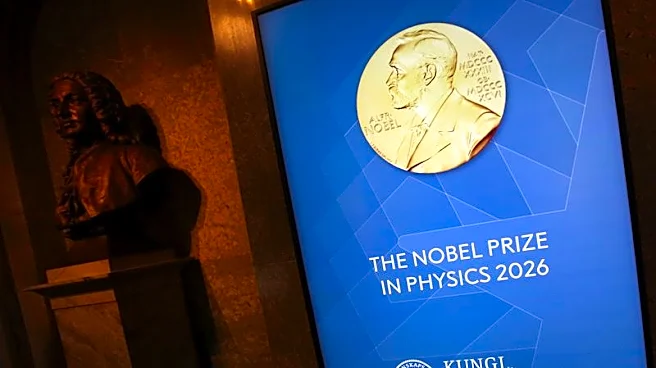
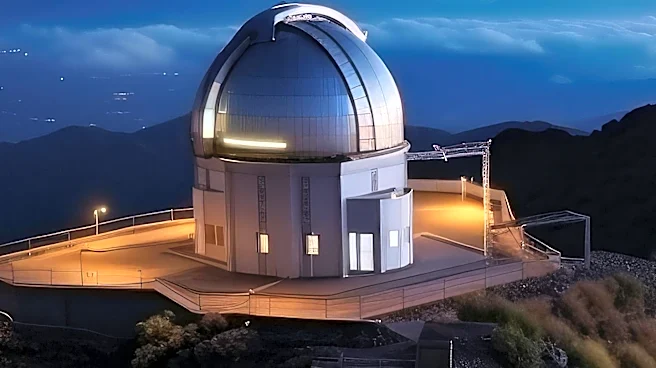
of stars orbiting the black hole. The extreme gravitational forces in this region explain the stars' rapid movement, despite the unlikelihood of their formation so close to a black hole, which typically rips apart gas and dust clouds. Researchers are using advanced techniques like adaptive optics and interferometry to overcome the challenges of observing the crowded and bright galactic center, which is also obscured by dust and gas. These methods have allowed scientists to precisely track stellar orbits, providing crucial data on Sagittarius A*'s mass and offering insights into its elusive spin. The work of scientists like Reinhard Genzel and Andrea Ghez, who received a Nobel Prize in 2020 for their contributions, has been instrumental in these advancements.
Why It's Important?
Understanding the properties of Sagittarius A*, particularly its spin, is crucial for unraveling fundamental mysteries about our galaxy and the universe. The black hole's spin could explain why it is significantly quieter than other supermassive black holes of similar size, with a remarkably low mass accretion rate. It might also shed light on the absence of a powerful jet, a common feature in many other supermassive black holes, whose size is often linked to the black hole's spin rate. The behavior of Sagittarius A* has implications for the Milky Way's past and future evolution. Furthermore, studying the extreme gravitational environment near Sagittarius A* provides a unique opportunity to test Albert Einstein's theory of general relativity in conditions where it might potentially break down, offering clues to resolving major problems in physics, such as the interplay between general relativity and quantum mechanics at the black hole's edge. The S stars serve as vital probes for this research, allowing scientists to investigate these extreme territories from a safe distance.
What's Next?
The discovery of stars like S301, which orbits Sagittarius A* much closer and faster than previously studied stars like S0-2, is expected to significantly accelerate the measurement of the black hole's spin. S301 completes an orbit in just 8.7 years, making it a more sensitive probe of the black hole's gravity. Researchers anticipate that a precise measurement of Sagittarius A*'s spin could be achieved within the next decade. This measurement will open an unprecedented window into the detailed behavior of our galaxy. Scientists will continue to meticulously collect and analyze decades of data to ensure accuracy, as errors can easily arise in such complex observations. The ongoing study of the galactic center is expected to reveal more about the three distinct groups of stars orbiting Sagittarius A* and potentially confirm the existence of other massive objects, like a smaller black hole or a dense star cluster, that could explain their varied orbits. The field is rapidly advancing, with more discoveries anticipated in the glare of the galactic center.
Beyond the Headlines
The ongoing research into Sagittarius A* and the stars orbiting it delves into profound questions about the fundamental laws of physics and the evolution of galaxies. The existence of young stars so close to a supermassive black hole challenges conventional understanding of star formation, suggesting complex dynamics like binary star systems being torn apart. The 'zone of avoidance,' a striking shortage of stars in close, circular orbits, further highlights the intricate gravitational interactions at play. The proposed unified model, suggesting an additional massive object near Sagittarius A*, could revolutionize our understanding of how these diverse stellar populations came to be. Beyond the astronomical implications, the quest to measure the black hole's spin and test general relativity in such extreme conditions pushes the boundaries of human knowledge, potentially leading to new theories that reconcile gravity with quantum mechanics. This research underscores the universe's capacity for unexpected phenomena and the continuous evolution of scientific understanding.