


What's Happening?
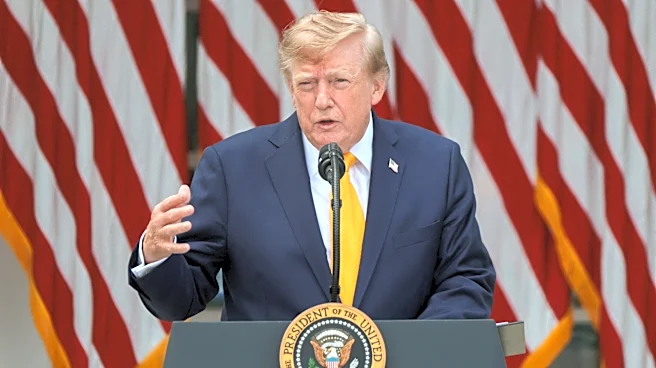
Recent polling indicates significant public opposition to President Trump's and Health and Human Services Secretary Robert Kennedy Jr.'s vaccine policies. A substantial 71% of Americans oppose President Trump changing vaccine schedules, with a strong
preference for doctors and scientists to make decisions regarding childhood vaccines. The polling also shows that 53% of voters view Republicans in Congress less favorably, and 44% much less so, when policies are tied to debunked allegations about vaccines causing autism. Furthermore, 51% feel less favorable towards Republicans upon hearing that a recent order dismantled 30 years of vaccine practice. This sentiment persists despite the polling sample including a significant number of President Trump and Kamala Harris supporters. Representative Anna Paulina Luna recently appeared at an event in Clearwater with Robert Kennedy Jr., further associating her with these unpopular policies.
Why It's Important?
The widespread unpopularity of these vaccine policies, as revealed by the poll, carries significant political implications for the Republican party, especially in upcoming elections. The data suggests that aligning with anti-vaccine stances, particularly those linked to discredited theories, could be a liability for Republican candidates. The decline in favorability among a broad spectrum of voters, including a notable portion of President Trump's base, indicates that public health issues, when framed around scientific consensus, can transcend traditional political divides. This could force Republican candidates to re-evaluate their positions on vaccine-related matters to avoid alienating a significant portion of the electorate. The involvement of figures like Representative Luna in events with Robert Kennedy Jr. further highlights the potential for these policies to become a focal point in political campaigns.
What's Next?
Science advocacy groups, such as 314 Action, are expected to intensify their efforts to pressure Republican candidates to disavow President Trump's anti-vaccine executive order and to align with scientific consensus on public health. These groups will likely use the polling data to drive their messaging, particularly in battleground districts. The issue of vaccine policy is poised to become a prominent campaign topic, with Democrats potentially leveraging the unpopularity of these stances to challenge Republican incumbents and candidates. Republicans may face increasing pressure to clarify their positions on vaccines, potentially leading to internal party debates or shifts in messaging to mitigate electoral risks. The ongoing public health discourse surrounding measles outbreaks and childhood vaccinations will likely keep this issue at the forefront of political discussions.
Beyond the Headlines
The strong public reaction to President Trump's and Robert Kennedy Jr.'s vaccine policies reflects a deeper societal tension between scientific authority and political influence in public health matters. The polling data underscores a public desire for evidence-based decision-making in health, rather than policies driven by political impulses or debunked theories. This situation highlights the critical role of trust in scientific institutions and medical professionals, especially in an era of widespread misinformation. The political fallout from these policies could have long-term implications for how public health crises are addressed in the U.S., potentially leading to a greater emphasis on scientific expertise in policy formulation. It also raises questions about the ethical responsibilities of political leaders to promote accurate health information and protect public well-being, rather than endorsing views that contradict established medical consensus.