




What's Happening?
Riccardo Fabiani, North Africa project director at the International Crisis Group, has expressed significant concern regarding the potential for military escalation in Western Sahara. This warning comes after the UN Security Council failed to renew the mandate
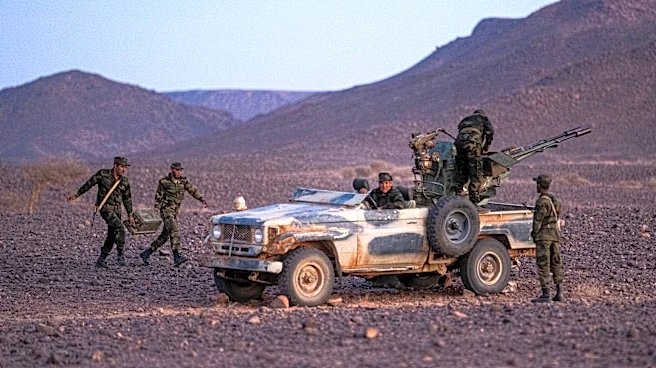
of its Western Sahara mission (Minurso), which had been in place for 35 years. The mission, established in 1991, was intended to monitor a ceasefire between Morocco and the Polisario Front and facilitate a referendum on the territory's future. However, the ceasefire collapsed in 2020, and the referendum never occurred. The recent failure to renew Minurso's mandate, due to vetoes from Russia and the US on each other's resolutions, has effectively ended the peace process. Fabiani highlights that without UN monitoring, the risk of a military incident in the buffer zone escalating into a larger conflict is significantly increased, potentially involving Morocco taking over the area and the Polisario Front launching attacks from Algerian territory.
Why It's Important?
The collapse of the UN mission in Western Sahara, as analyzed by the International Crisis Group, signifies a critical turning point for regional stability in North Africa. The absence of an international monitoring presence removes a crucial deterrent against military actions, making the long-standing conflict between Morocco and the Polisario Front more volatile. This situation could lead to a renewed armed conflict, potentially drawing in Algeria, which backs the Polisario Front. Such an escalation would have severe humanitarian consequences, exacerbating the plight of Sahrawi refugees and potentially creating new displacement crises. Furthermore, increased instability in North Africa could have broader implications for European security, including potential refugee flows and disruptions to regional trade and energy supplies. The failure of the UN Security Council to find common ground also underscores challenges in international diplomacy and conflict resolution, particularly in protracted disputes that have fallen off the global radar.
What's Next?
With the UN mission dissolved, the immediate future for Western Sahara is fraught with uncertainty and increased risk of military confrontation. The Polisario Front has indicated that the alternative to diplomacy is war, while Morocco has stated its commitment to a ceasefire but also to protecting its territorial integrity. Riccardo Fabiani's assessment suggests that any military incident in the unmonitored buffer zone could quickly escalate. The UN has already begun liquidating its operations, handing assets over to Morocco. This vacuum of international oversight means that both sides might perceive opportunities to assert control or launch offensives, potentially leading to a full-scale conflict. The international community, particularly the US and European nations, will face pressure to re-engage diplomatically to prevent a humanitarian crisis and regional destabilization, though the path forward remains unclear given the recent Security Council deadlock.
Beyond the Headlines
The situation in Western Sahara, as highlighted by the International Crisis Group, reveals deeper systemic issues in international conflict resolution and the geopolitical landscape. The conflict, often overshadowed by other global crises, represents a 'forgotten' dispute with significant human rights implications for the Sahrawi people. The US decision in 2020 to recognize Morocco's sovereignty over the territory in exchange for normalization with Israel further complicated the diplomatic landscape, undermining the UN's long-standing efforts for a referendum. This shift in US policy, coupled with the recent UN Security Council failure, signals a potential decline in the international community's commitment to self-determination principles in certain contexts. The long-term implications include the potential for increased regional proxy conflicts, a weakening of international law, and a precedent where geopolitical interests override established peace processes, leaving vulnerable populations in prolonged states of conflict and displacement.