






What's Happening?
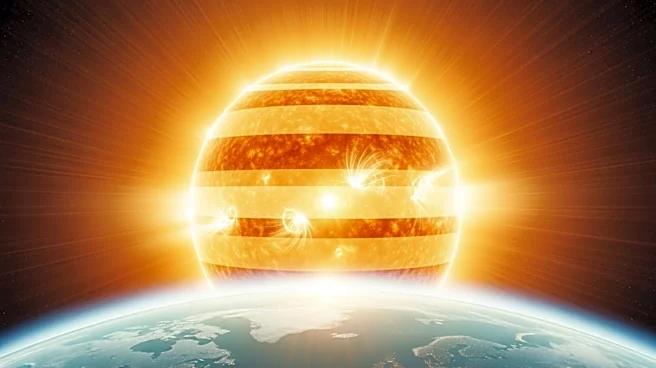
Sunlight takes approximately eight minutes to travel from the Sun to Earth, but the energy in that sunlight was generated in the Sun's core through nuclear fusion tens to hundreds of thousands of years ago. This energy is produced by the fusion of hydrogen
nuclei into helium, releasing high-energy gamma-ray photons at extremely high temperatures. The photons then take a 'drunken walk' through the Sun's radiative zone, a process that involves being repeatedly absorbed and re-emitted by atoms, which can take up to 170,000 years. This journey is significantly longer than the final eight-minute trip to Earth. The energy eventually reaches the Sun's surface, where it is emitted as visible light, completing its long journey to Earth.
Why It's Important?
Understanding the journey of solar energy from the Sun's core to Earth highlights the complexity and time scale of energy production in stars. This knowledge is crucial for astrophysics and helps in comprehending the processes that power our solar system. The long timescale of energy migration within the Sun underscores the stability and longevity of solar energy output, which is vital for life on Earth. This insight into solar processes also informs the development of solar energy technologies and enhances our understanding of stellar physics, contributing to scientific advancements in energy and space exploration.