








What's Happening?
Austin Happel, a researcher at Shedd Aquarium, has been tracking fish movement in the Chicago River using telemetry tags to understand their habitat use and behavior. His research has overturned previous assumptions, particularly regarding bluegills.
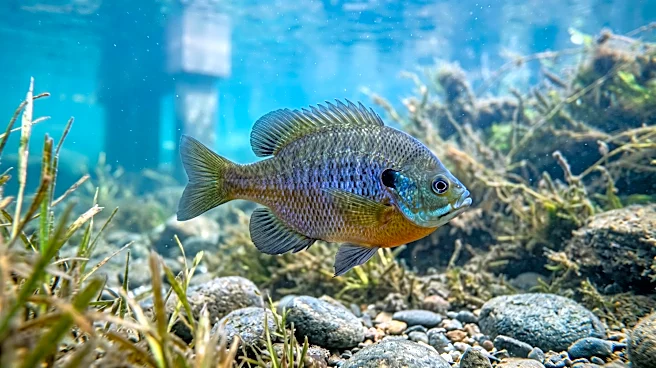
While some bluegills exhibited typical 'homebody' behavior, others displayed an unexpected range. One-third of the 15 tagged bluegills covered five miles or more in a single day, with one individual, dubbed the 'marathoner,' swimming nearly 7.5 miles daily on multiple occasions. This level of endurance, scaled to human size, is equivalent to swimming 52 miles, a distance comparable to Navy Pier to Racine, Wisconsin. Happel calculated that this bluegill moved at 4,000 body lengths per hour, surpassing the 3,000 body lengths per hour of an elite human marathon swimmer. This finding highlights the remarkable athletic capabilities of fish in the Chicago River, a waterway that is home to approximately 80 species.
Why It's Important?
This research is important for several reasons. Firstly, it provides new insights into the ecological behavior of fish species in urban river systems, challenging preconceived notions about their movement patterns. Understanding these patterns is crucial for effective conservation and habitat restoration efforts in the Chicago River and similar environments. Secondly, the study underscores the resilience of aquatic life in an urbanized river, even amidst environmental challenges like combined sewer overflows. These overflows, which introduce untreated wastewater into the river, can deplete oxygen levels, forcing fish to disperse. Happel's tracking data indicates that fish move to areas like the Riverwalk, where Lake Michigan water mixes with the river, during such events. This highlights the importance of water quality and the need for continued infrastructure improvements, such as the Deep Tunnel system, to protect aquatic ecosystems. The research also indirectly promotes public engagement with the river, as events like the Chicago River Swim, while a novelty for humans, draw attention to the river's health and the need for its preservation.
What's Next?
Happel plans to analyze the data from this year's combined sewer overflows to determine if fish that dispersed during these events returned to their original habitats or remained in areas with better water quality. This analysis will provide further understanding of fish resilience and habitat preferences in response to environmental stressors. The ongoing research will continue to inform conservation strategies and public awareness campaigns aimed at improving the health of the Chicago River. Increased public interest in recreational activities in the river, spurred by events like the Chicago River Swim, is expected to generate more support and funding for ecosystem maintenance and management. Future efforts will likely focus on mitigating the impact of pollution events and enhancing habitat quality to support the diverse aquatic life of the Chicago River.
Beyond the Headlines
The Shedd Aquarium's research on bluegill movement in the Chicago River offers a deeper perspective on the often-overlooked ecological dynamics within urban environments. Beyond the immediate findings, it prompts reflection on the adaptability of nature in human-altered landscapes. The 'marathoner' bluegill serves as a powerful symbol of this resilience, demonstrating that even in a river impacted by urban infrastructure and pollution, life finds ways to thrive and exhibit extraordinary capabilities. This challenges the common perception of urban rivers as solely conduits for waste or recreational spaces, re-emphasizing their role as vital ecosystems. The study also subtly highlights the ethical responsibility of urban planning and environmental management to consider the non-human inhabitants of these spaces. The comparison between human and fish endurance, while lighthearted, underscores the inherent biological efficiencies of aquatic life and the need for humans to respect and protect these natural systems, rather than merely coexisting with them.