



What's Happening?
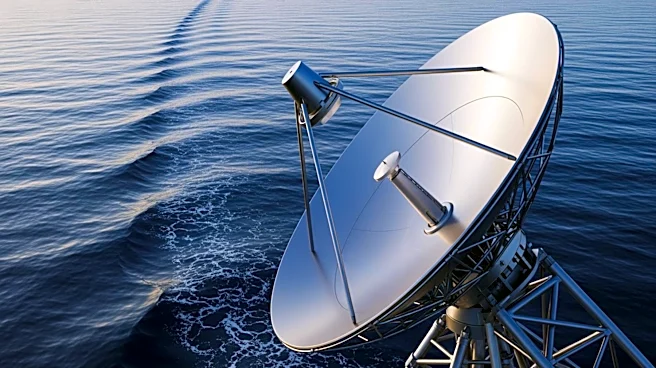
Researchers have developed a new method using geostationary satellites to observe ocean currents with unprecedented detail. The technique involves the use of the GOFLOW model, which leverages high-resolution ocean model data and geostationary satellite infrared
brightness temperature data to predict surface velocity fields. This approach allows for the observation of mesoscale and submesoscale ocean dynamics, providing a more comprehensive understanding of ocean circulation patterns. The method addresses challenges such as cloud cover and internal tides, offering a more accurate representation of ocean currents.
Why It's Important?
This advancement in observing ocean currents has significant implications for climate science, marine navigation, and environmental monitoring. Accurate data on ocean circulation is crucial for understanding climate change impacts, as ocean currents play a key role in heat distribution across the planet. Improved ocean current models can enhance weather forecasting and climate predictions. Additionally, this technology can aid in the management of marine resources and the monitoring of environmental changes, such as oil spills and marine pollution.