



What's Happening?
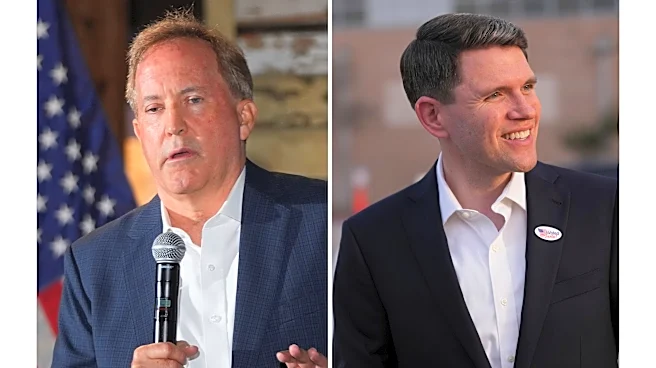
Republican Attorney General Ken Paxton has released an AI-generated attack ad targeting Democratic State Representative James Talarico in the Texas Senate contest. The 30-second ad, posted on Paxton's official X account, features an AI-generated likeness
of Talarico reading from a fictional 'King James Talarico Bible.' The synthetic character recites a passage that combines separate religious remarks Talarico previously made about Christianity, gender, and Jesus, creating the appearance of a continuous performance that did not actually occur. The ad's caption claims Talarico is 'weaponizing faith to sell a radical agenda' and 'brags about hating Christianity.' This use of generative AI in political advertising has sparked debate, with some commentators, like journalist Mehdi Hasan, calling for such ads to be illegal.
Why It's Important?
The use of AI-generated deepfakes in political campaigns, as demonstrated by Ken Paxton's ad, marks a significant and potentially problematic evolution in political advertising. This technology allows for the creation of highly realistic, yet entirely fabricated, content that can mislead voters and distort candidates' positions. The ability to combine disparate statements into a seamless, fictional narrative raises serious concerns about truthfulness and the integrity of democratic discourse. For voters, it becomes increasingly difficult to discern genuine remarks from AI-generated fabrications, potentially eroding trust in political information and making informed decision-making more challenging. This development could lead to a new era of 'information warfare' in elections, where the line between fact and fiction is blurred, impacting public perception and electoral outcomes.
What's Next?
The controversy surrounding Paxton's AI ad is likely to intensify discussions about the regulation of artificial intelligence in political campaigns. Lawmakers and advocacy groups may push for legislation to mandate disclosure for AI-generated content in political advertising or even outright ban certain types of deepfakes. The immediate impact on the Texas Senate race will depend on how voters react to the ad and whether the AI controversy sways public opinion. James Talarico's campaign is countering by focusing on allegations of misconduct against Paxton, featuring former aide David Maxwell in a new ad. The outcome of this election could set a precedent for the effectiveness and ethical implications of AI in future political contests, potentially influencing how campaigns nationwide approach digital advertising and truthfulness.
Beyond the Headlines
The deployment of AI-generated attack ads like Paxton's highlights deeper ethical and societal implications regarding the intersection of technology and democracy. The ease with which AI can create convincing but false narratives challenges the very foundation of public trust and shared reality. This technology could be exploited to manipulate public opinion, spread disinformation, and undermine electoral processes on a grand scale. Beyond politics, the proliferation of deepfakes raises questions about individual reputation, the nature of evidence, and the potential for widespread deception in various aspects of life. Addressing this challenge will require not only legislative action but also increased media literacy among the public and the development of robust AI detection tools to safeguard against malicious uses of this powerful technology.