






What's Happening?
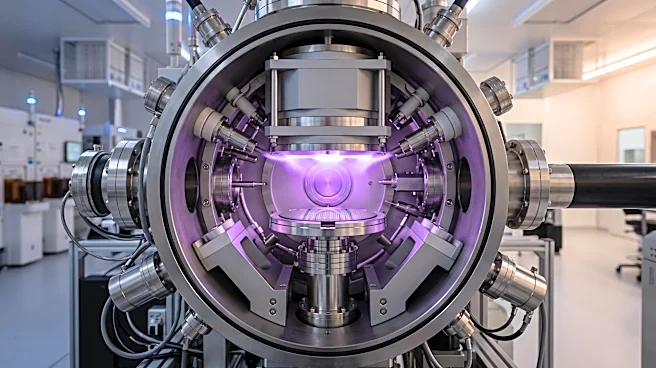
General Fusion Group Ltd., a leading fusion company, has announced a significant achievement in its Magnetized Target Fusion (MTF) technology. The company successfully heated plasma to electron temperatures exceeding 12 million degrees Celsius (more than
1 keV) using its large-scale Lawson Machine 26 (LM26) demonstration. This compressional plasma heating result was co-published by the UK Atomic Energy Authority (UKAEA), the UK’s national fusion laboratory, and validated using Thomson scattering methods. This milestone is particularly notable as only a few fusion companies have surpassed the 1 keV threshold, and General Fusion is the first to do so with its MTF approach, which utilizes low-speed compression. The LM26 program aims to achieve fusion in a practical and economical manner by employing a liquid metal wall, which allows for the use of existing materials and avoids the need for superconducting magnets and high-powered lasers. This development is a crucial step in the company's goal to deliver baseload, economical clean power from fusion energy.
Why It's Important?
This achievement by General Fusion represents a significant advancement in the global pursuit of commercial fusion energy. The ability to reach electron temperatures exceeding 12 million degrees Celsius using MTF technology demonstrates progress towards a viable method for generating clean, carbon-free power. Fusion energy, if successfully commercialized, has the potential to revolutionize the energy sector by providing a virtually limitless and environmentally friendly power source, reducing reliance on fossil fuels and mitigating climate change. For the U.S. and other nations, this could lead to enhanced energy security, stable electricity prices, and a substantial reduction in greenhouse gas emissions. The MTF approach, with its focus on practical and economical solutions, could accelerate the timeline for fusion power plant deployment, potentially impacting industries ranging from manufacturing to transportation as electricity demand continues to surge globally. This breakthrough also highlights the importance of international collaboration in scientific research, as evidenced by the partnership between General Fusion and UKAEA.
What's Next?
General Fusion is continuing to advance its LM26 program with upcoming milestones. Upgrades to the LM26 machine are currently underway to support higher plasma compression ratios, with the next target being the 10 keV milestone. Following this, the program will aim to achieve the Lawson criterion, which represents the combination of temperature, density, and energy confinement time necessary for net fusion energy in the plasma. The company's phased commercialization plan is designed to de-risk the path to practical fusion power, with the ultimate goal of operating a first-of-a-kind plant around 2035. The technical paper detailing the recent results is being submitted for peer review, which will further validate the scientific findings. Continued collaboration with organizations like UKAEA and General Atomics Energy Group will be crucial for optimizing diagnostic systems and advancing the technology. The success of these future milestones will determine the feasibility and timeline for commercial fusion energy, potentially attracting further investment and accelerating the development of fusion power plants.
Beyond the Headlines
The successful heating of plasma to over 12 million degrees Celsius by General Fusion carries deeper implications beyond immediate scientific progress. This development underscores a broader shift in the energy landscape, where private companies are increasingly playing a pivotal role in advancing complex, long-term energy solutions like fusion. The MTF approach, which aims for practicality and economic viability by avoiding some of the more extreme engineering challenges of other fusion methods, could set a precedent for how future energy technologies are developed and deployed. If successful, this could lead to a re-evaluation of energy infrastructure investments and policy, potentially favoring decentralized, clean energy sources. Furthermore, the collaboration between General Fusion and UKAEA highlights the growing importance of international partnerships in tackling global challenges such as climate change and energy security. This milestone could also inspire a new generation of scientists and engineers to pursue careers in fusion research, fostering innovation and accelerating the transition to a sustainable energy future.