
What's Happening?
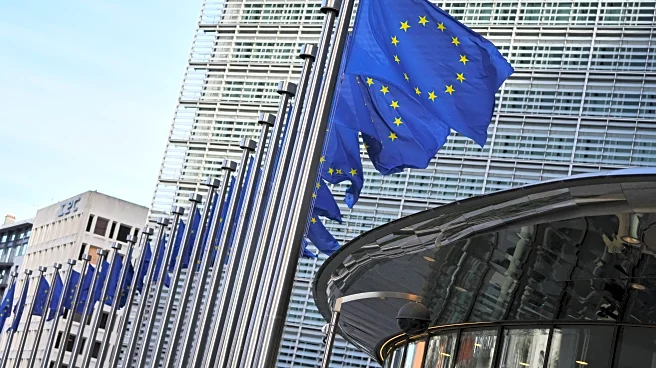
A prominent member of the European Parliament, David McAllister, has emphasized the need to separate the EU-US trade deal from the ongoing dispute over Greenland. McAllister, who chairs the European Parliament's
committee on foreign affairs, stated that the ratification of the trade agreement, signed last summer between the EU and the United States, should not be hindered by the tensions surrounding Greenland. The trade deal, which was agreed upon by President Trump and European Commission President Ursula von der Leyen, involves tripling tariffs on EU products while eliminating tariffs on industrial goods from the US. Despite the US's push for full ratification, some members of the European Parliament are considering blocking the process in response to President Trump's claims over Greenland. McAllister highlighted the differing opinions within the Parliament, with some political groups supporting the deal's approval and others advocating for a delay.
Why It's Important?
The separation of the EU-US trade deal from the Greenland dispute is crucial for maintaining economic stability and predictability for businesses on both sides of the Atlantic. The trade agreement is significant as it aims to enhance economic ties by reducing tariffs, which could benefit industries and consumers in both regions. However, the geopolitical tensions over Greenland, a territory rich in rare earth minerals, pose a challenge to the ratification process. The European Parliament's decision on whether to proceed with the trade deal could impact transatlantic relations and economic cooperation. Additionally, the situation underscores the complexities of international diplomacy, where economic agreements can be influenced by unrelated geopolitical issues.
What's Next?
The European Parliament is expected to continue deliberations on the trade deal, with political groups expressing varying stances. The EPP and European Conservatives are in favor of moving forward with the agreement, while Socialists, liberals, and greens may seek to postpone the vote. The Parliament has also issued a statement supporting Greenland and Denmark, condemning the US's aggressive rhetoric. As discussions progress, the outcome will likely depend on the ability of EU leaders to balance economic interests with geopolitical considerations. The EU's commitment to Greenland, including increased financial support, may also play a role in shaping future negotiations.