

What's Happening?
Recent research suggests that transforming Mars into a habitable planet is becoming a feasible scientific goal. Advances in synthetic biology and planetary engineering are at the forefront of this initiative. The study, led by Erika DeBenedictis and Devon
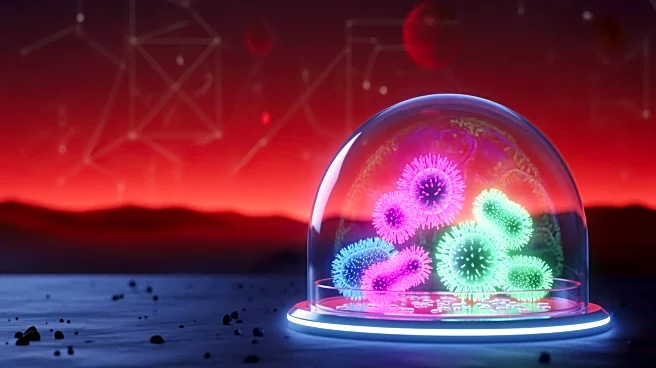
Stork, outlines a phased plan to make Mars more Earth-like, starting with atmospheric warming and potentially leading to fully habitable ecosystems. The initial step involves raising the Martian temperature to melt frozen water reservoirs, which could stabilize liquid water on the surface. This would be followed by introducing genetically-engineered microbes capable of surviving Mars' harsh conditions. However, the plan faces significant scientific uncertainties and ethical concerns, including the potential erasure of evidence of indigenous Martian life.
Why It's Important?
The potential to terraform Mars represents a significant shift in how humanity views space exploration and planetary science. If successful, it could pave the way for human colonization of other planets, offering a solution to Earth's overpopulation and resource depletion issues. The research also highlights the role of synthetic biology in addressing ecological challenges, both on Mars and Earth. However, the ethical implications are profound, as altering Mars' environment could destroy its natural state and any existing life forms. This raises questions about humanity's responsibility to preserve extraterrestrial environments.
What's Next?
The next steps involve moving from theoretical research to practical experimentation, possibly during upcoming Mars missions. This includes localized tests to assess the feasibility of warming Mars' atmosphere and introducing extremophiles. The scientific community remains divided on the ethical implications, and further debate is expected as the research progresses. The potential for international collaboration or conflict over Mars' future also looms, as space agencies and private companies may have differing visions for the planet.
Beyond the Headlines
The concept of terraforming Mars challenges traditional views of planetary exploration, shifting the focus from discovery to environmental engineering. It raises philosophical questions about humanity's role in the universe and our right to alter other worlds. The project could also drive technological advancements in climate simulation and closed-loop life support systems, with potential applications on Earth. However, the risk of irreversible changes to Mars' environment underscores the need for careful consideration and international consensus.