



What's Happening?
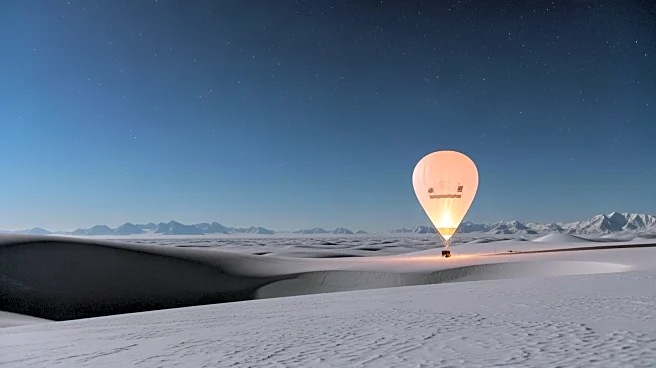
NASA has successfully completed a series of scientific balloon flights from Antarctica, part of a long-duration campaign that began in early December. The balloons, launched from a facility near the U.S. National Science Foundation’s McMurdo Station,
carried payloads designed to advance astrophysics research. The General AntiParticle Spectrometer (GAPS) balloon, launched on December 15, aimed to detect anti-matter particles entering Earth's atmosphere, contributing to the understanding of dark matter. The Payload for Ultrahigh Energy Observations (PUEO), launched on December 19, focused on detecting signals from neutrinos, high-energy particles that provide insights into cosmic events. The campaign also included two secondary balloons carrying radio beacons to support the PUEO mission. These zero-pressure balloons, designed for extended-duration flights, maintained equilibrium with their surroundings, making them suitable for the Antarctic environment.
Why It's Important?
This campaign is significant for the field of astrophysics as it enhances the understanding of dark matter and neutrinos, which are crucial for comprehending the universe's fundamental components. The data collected from these missions can provide insights into the origins of dark matter and the behavior of neutrinos, which travel across the universe carrying information about distant cosmic events. The success of these balloon flights demonstrates the effectiveness of using scientific balloons for long-duration missions in extreme environments, potentially leading to more cost-effective and flexible research opportunities compared to traditional space missions. The findings could influence future astrophysics research and contribute to the broader scientific understanding of the universe.
What's Next?
Following the successful completion of these flights, the data collected will be analyzed to extract valuable scientific insights. The results could lead to further research initiatives and potentially new missions to explore dark matter and neutrinos. NASA's continued investment in scientific balloon programs may result in more frequent and diverse missions, expanding the scope of research conducted in extreme environments like Antarctica. The outcomes of this campaign could also inform the development of new technologies and methodologies for future astrophysics research.