






What's Happening?
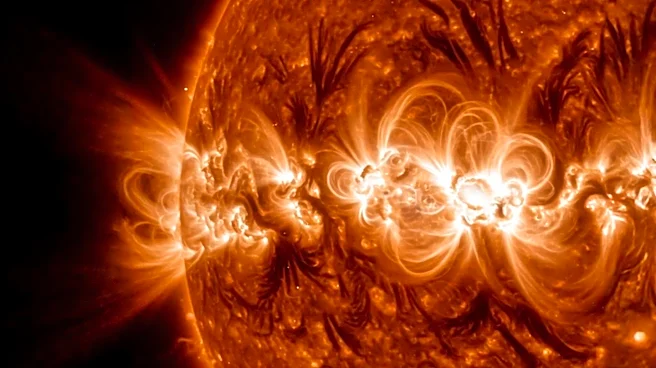
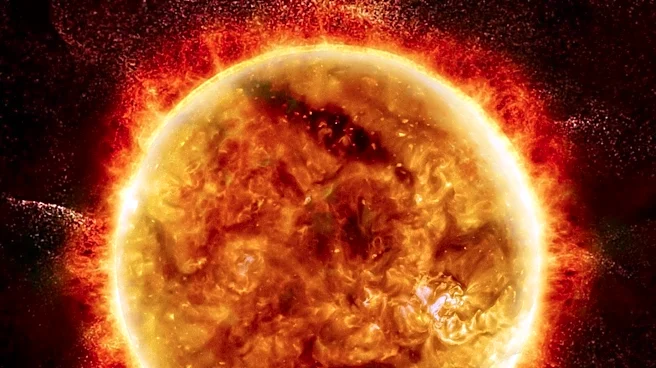
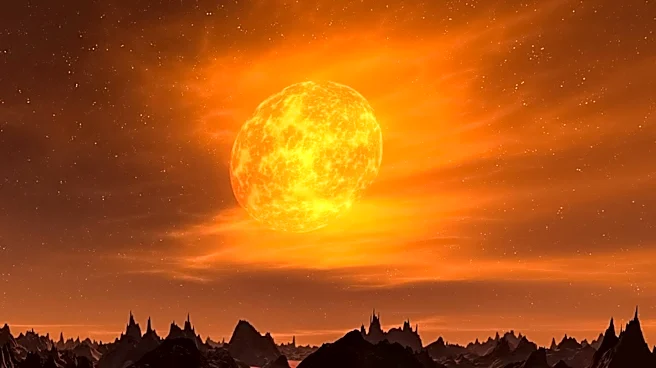
A recent coronal mass ejection (CME) from the Sun has launched approximately a trillion kilograms of charged plasma towards Earth. These CMEs are massive clouds of plasma that can travel through the solar system at extraordinary speeds, sometimes reaching
Earth in less than 18 hours. The current CME is part of the Sun's 11-year activity cycle, which sees an increase in such events during solar maximum. The CME's speed and magnetic orientation are critical factors in determining its impact on Earth's magnetic field. Instruments on spacecraft positioned near the L1 point, about 1.5 million kilometers from Earth, can measure these parameters, providing a short warning period before the CME reaches Earth. This warning allows for some protective measures to be taken, such as adjusting power grid operations and satellite configurations.
Why It's Important?
The impact of a CME on Earth can be significant, particularly for technological systems. When a CME interacts with Earth's magnetic field, it can induce currents in power lines, potentially leading to power outages, as seen in the 1989 Hydro-Québec blackout. The increased solar activity during the solar maximum period raises the likelihood of such events, posing a risk to power grids, satellites, and communication systems. Understanding and predicting CMEs are crucial for mitigating their effects on modern infrastructure, which is increasingly reliant on technology vulnerable to solar storms.
What's Next?
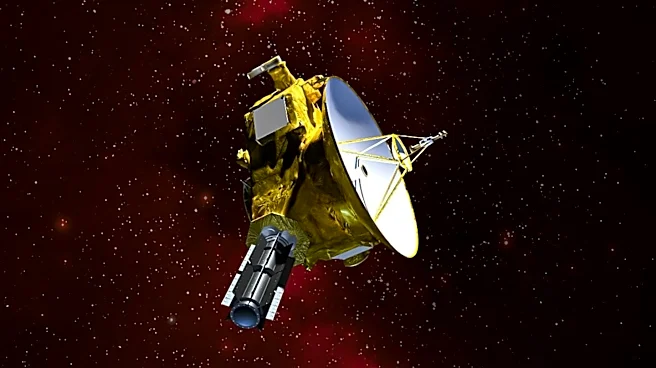
As solar activity continues to peak, scientists and engineers are focused on improving forecasting models and protective measures. The European Space Agency and other organizations conduct exercises to prepare for potential geomagnetic storms. Continued monitoring by spacecraft like NASA's Parker Solar Probe and ESA's Solar Orbiter is essential for providing timely warnings. These efforts aim to enhance the resilience of critical infrastructure against solar-induced disruptions.
Beyond the Headlines
The broader implications of increased solar activity extend beyond immediate technological impacts. The potential for severe geomagnetic storms highlights the need for international cooperation in space weather monitoring and response. Additionally, understanding solar phenomena contributes to our knowledge of other stars and their potential effects on exoplanets, which is crucial for assessing the habitability of planets in other solar systems.