
What's Happening?
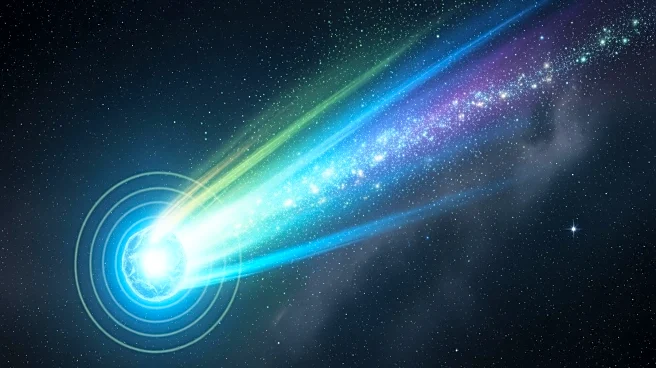
Comet 3I/ATLAS, the third confirmed interstellar object to visit our solar system, is drawing significant attention due to its unusual chemical composition and radio signals. Unlike typical solar system comets,
3I/ATLAS originated from beyond our solar system, approaching from a direction perpendicular to the Milky Way's center. Observations from the James Webb Space Telescope and other observatories have revealed that the comet's nucleus emits high levels of methanol, hydrogen cyanide, and carbon dioxide, which are atypical for solar comets. Additionally, the MeerKAT radio telescope detected natural radio absorption features from the comet, sparking speculation about its origins. However, these signals are attributed to natural processes rather than artificial transmissions.
Why It's Important?
The study of Comet 3I/ATLAS offers a rare opportunity to understand the diversity of cosmic bodies and the environments of planetary systems beyond our own. Its unique chemistry provides insights into the building blocks of worlds outside our solar neighborhood. The comet's passage allows scientists to study interstellar material's origins and evolution, potentially unlocking secrets about the formation of planetary systems. The scientific community is particularly interested in the comet's unusual characteristics, which challenge existing models of cometary behavior and composition.
What's Next?
As Comet 3I/ATLAS continues its journey, astronomers will use telescopes like the James Webb Space Telescope to track changes in its composition and behavior. This ongoing study aims to enhance our understanding of how interstellar bodies form and interact with their environments. The comet will remain observable into spring 2026, providing further opportunities for both professional astronomers and amateur skywatchers to study this interstellar visitor.