







What's Happening?
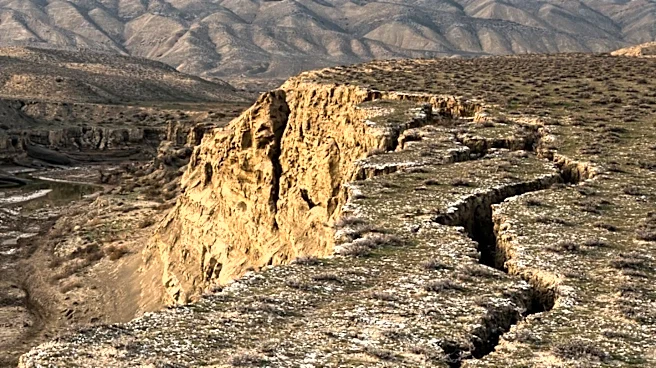
On August 19, at 5:36 a.m., a 5.6 magnitude earthquake struck Dachaidani in the Haibei Mongol-Tibetan Autonomous Prefecture of Qinghai Province, China. The tremors were strongly felt in the Dachaidani area, as reported by ECNS, citing the Qinghai Provincial
Earthquake Administration. Following the initial quake, the provincial agency dispatched two vehicles and eight staff members to initiate emergency response operations. An aftershock with a magnitude of 3.4 was recorded at 5:59 a.m. in Dachaiduan, with its epicenter located at a depth of 10 kilometers. According to the China Earthquake Networks Center, one village is located within five kilometers of the epicenter, and the town of Dachaidan is within 50 kilometers.
Why It's Important?
Earthquakes of this magnitude, even in sparsely populated areas, pose significant risks to infrastructure and local communities. While the immediate reports do not detail extensive damage or casualties, the strong tremors indicate a potential for structural damage to buildings and disruption to essential services. The dispatch of emergency response teams highlights the proactive measures taken by authorities to assess the situation and provide aid, which is crucial in mitigating the impact of natural disasters. The occurrence of an aftershock further emphasizes the ongoing seismic activity and the need for continued vigilance. For the affected region, this event underscores the importance of earthquake-resistant construction and robust emergency preparedness plans to protect residents and minimize potential losses.
What's Next?
Emergency response teams will continue to assess the full extent of the earthquake's impact, focusing on potential damage to infrastructure, residential buildings, and any reported injuries. Authorities will monitor for further aftershocks and provide guidance to residents on safety measures. The China Earthquake Networks Center and the Qinghai Provincial Earthquake Administration will likely release more detailed reports on the seismic activity and its geological implications. Depending on the assessment, there may be efforts to reinforce structures, educate the public on earthquake safety, and review regional disaster preparedness protocols to enhance resilience against future seismic events. The long-term focus will be on recovery and strengthening the region's capacity to withstand natural disasters.
Beyond the Headlines
This earthquake, while localized, contributes to the broader understanding of seismic activity in China, a country frequently affected by such natural phenomena. It highlights the continuous challenge of balancing economic development with geological risks, particularly in regions with diverse ethnic populations like the Haibei Mongol-Tibetan Autonomous Prefecture. The event could spur further investment in seismic monitoring technology and early warning systems, not just for immediate safety but also for long-term urban and rural planning. It also brings to light the resilience of local communities and the effectiveness of governmental disaster response mechanisms in managing and recovering from natural disasters, potentially influencing national disaster management strategies and international cooperation in seismology.