

What's Happening?
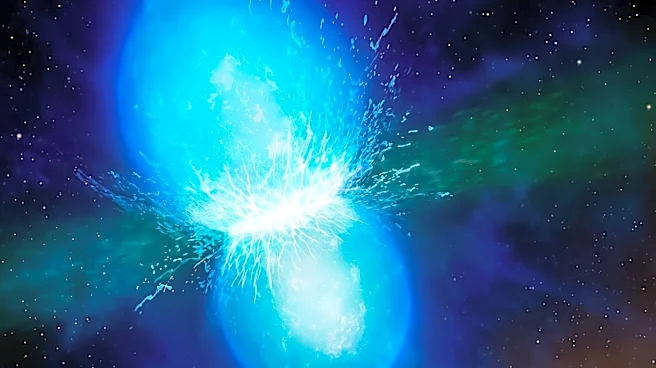
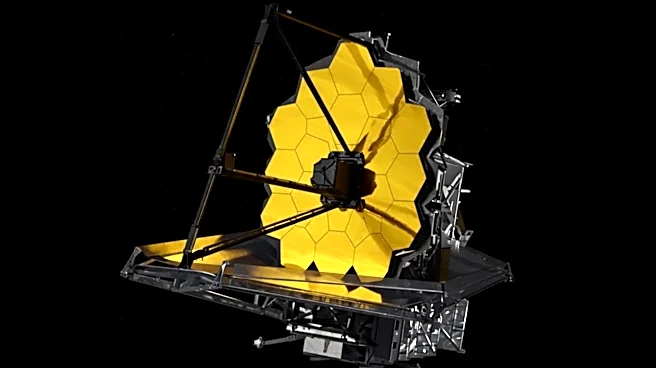
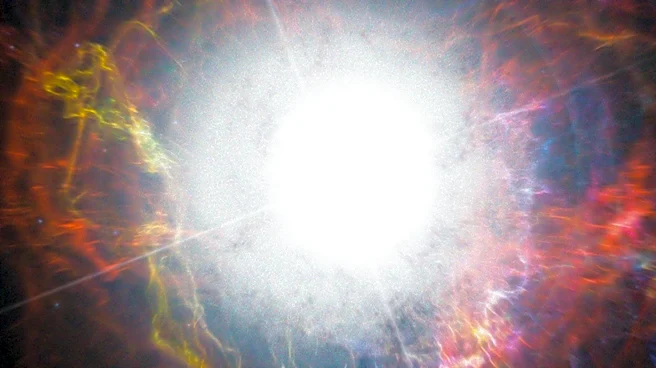
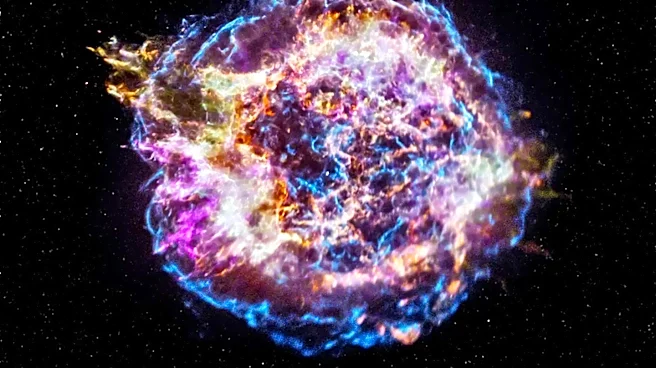
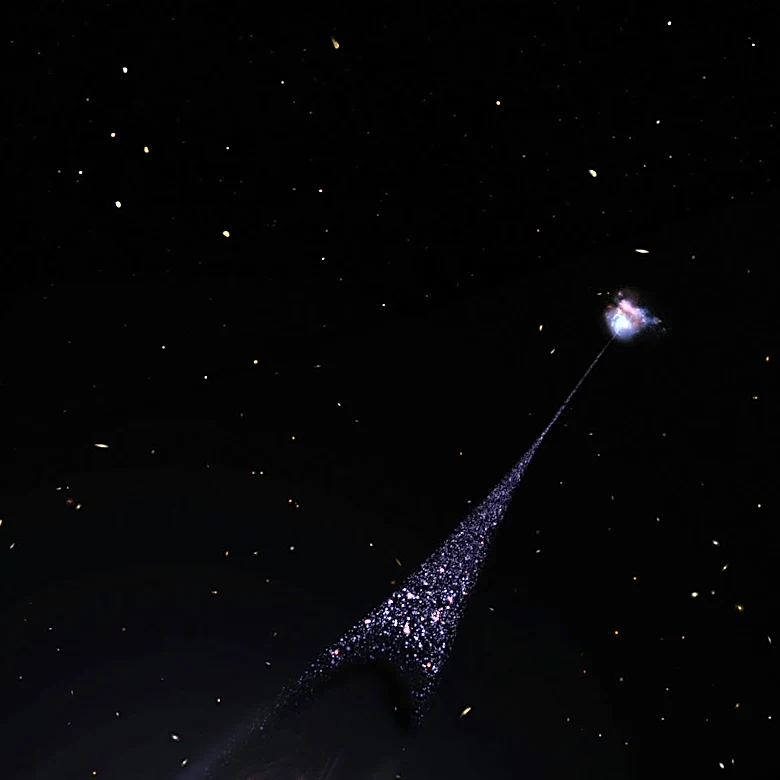
Astronomers have released the most detailed image to date of the Pa 30 nebula, the remnant of a supernova believed to have been observed nearly a millennium ago. The new observations, made using the Gemini North telescope in Hawaii, reveal approximately
ten times more structures than previously seen. Instead of continuous filaments, the remnant now appears as long, string-like formations adorned with 'cosmic pearls'—knots of gas that are remarkably uniform in size. Each of these pearl-like knots measures about four light-days in diameter, large enough to contain the planetary region of our solar system ten times over. The study, published in The Astrophysical Journal, highlights the unexpected regularity of these structures, which challenges previous assumptions about the aftermath of supernova explosions. Researchers are now working to model these unique formations to better understand stellar death.
Why It's Important?
This discovery significantly advances our understanding of supernova remnants and the processes that occur after a star's explosive death. The unexpected uniformity and alignment of the 'cosmic pearls' provide new data points that could refine existing astrophysical models. Supernovae are crucial for distributing heavy elements throughout the universe, which are essential for the formation of new stars, planets, and ultimately, life. By understanding the precise mechanisms of these explosions and their aftermath, scientists can gain deeper insights into cosmic evolution and the origins of matter. The high-resolution imaging capabilities demonstrated by the Gemini North telescope also underscore the importance of advanced observational technology in pushing the boundaries of astronomical discovery, potentially leading to further breakthroughs in our comprehension of the cosmos.
What's Next?
Researchers plan to develop models to explain the formation and regularity of these 'cosmic pearls.' Understanding why these knots of gas are so uniform in size and aligned along the filaments is a key next step. This modeling effort could lead to new theories about the dynamics of material ejected during a supernova and how it interacts with the surrounding interstellar medium. Future observations with even more advanced telescopes may provide additional data to test these models and further resolve the intricate structures within the Pa 30 nebula. The insights gained from this study could also inform the search for and analysis of other supernova remnants, potentially revealing similar unexpected patterns that could revolutionize our understanding of stellar life cycles.
Beyond the Headlines
The discovery of these 'cosmic pearls' challenges the conventional view of supernova remnants as chaotic and irregularly shaped. The surprising order and uniformity suggest underlying physical processes that are not yet fully understood. This could imply a more structured or predictable aftermath to stellar explosions than previously thought, potentially linked to the star's pre-supernova state or the specific conditions of the explosion. The sheer scale of these 'pearls,' each capable of engulfing our solar system's planetary region multiple times, also offers a profound perspective on the vastness and power of cosmic phenomena. This finding encourages a re-evaluation of existing theoretical frameworks and highlights the continuous capacity of the universe to surprise and inform scientific inquiry, pushing the boundaries of human knowledge about our cosmic origins.