




What's Happening?
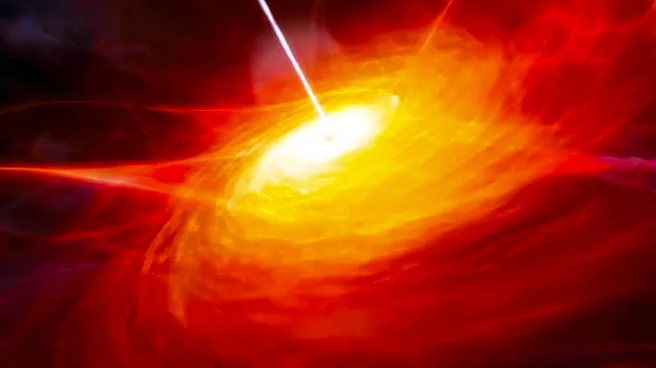
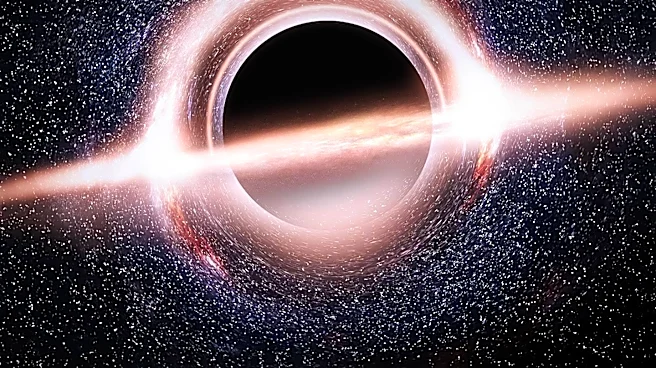
Theoretical physicists, including José Ferreira, Carlos Herdeiro, Eugen Radu, and Miguel Zilhão of the University of Aveiro in Portugal, have proposed a new method of black hole decay. Their research suggests that a 'hairy' black hole, one surrounded
by a scalar field, could potentially eject itself, leaving behind a boson star. This phenomenon, termed 'fission,' occurs when the black hole and its scalar field separate into two independent objects: a 'bald' black hole and a self-gravitating boson star. This contrasts with the more expected outcome of 'absorption,' where the black hole consumes the scalar field. The mechanism relies on the instability of the equilibrium between the black hole and its surrounding scalar structure, where a slight disturbance can cause the black hole to move off-center and eventually separate from the scalar field. The researchers emphasize that this is currently a 'toy model' and not a realistic representation of astrophysical black holes, as it relies on ordinary electric charge, which astrophysical black holes are not expected to possess in significant amounts.
Why It's Important?
This theoretical development is significant because it challenges the long-held understanding of black holes as nearly inviolable objects that only grow larger. By proposing a mechanism for black hole decay and the formation of boson stars, the research opens new avenues for exploring fundamental physics in extreme cosmic environments. Black holes serve as unique laboratories for probing forms of matter and fields that are otherwise difficult to detect. If a black hole could support exotic 'hair' and undergo such fission, it could offer crucial clues about particles or fields beyond our current knowledge. The study also highlights the importance of numerical simulations in understanding complex astrophysical phenomena, even if the specific model is theoretical. The potential for such a violent symmetry-breaking process to generate characteristic gravitational-wave signals could also have implications for future gravitational-wave astronomy, providing unique signatures to look for in the cosmos.
What's Next?
The researchers plan to investigate whether rotation could play a similar role to electric charge in other models of hairy black holes, potentially making the mechanism more astrophysically plausible. A key next step is to determine if an astrophysically realistic version of this instability exists and what its observable consequences would be. Specifically, they aim to calculate the gravitational-wave signals that such a fission event would produce. This would involve detailed studies to determine the exact waveforms and whether they could be realistically detected and distinguished from other known gravitational-wave sources. Such predictions would be crucial for guiding future observational efforts and potentially confirming the existence of these exotic phenomena. Further research will also focus on refining the 'toy model' to incorporate more realistic astrophysical conditions, moving closer to understanding if such events could occur in the actual universe.
Beyond the Headlines
The concept of black holes 'spitting themselves out' and forming boson stars delves into the deeper, less obvious implications of theoretical physics. It pushes the boundaries of our understanding of spacetime and matter under extreme conditions. The idea of 'hair' on black holes, representing additional parameters beyond mass and spin, suggests a richer and more complex reality than previously assumed by standard general relativity. This research encourages a re-evaluation of what constitutes a 'stable' cosmic object and how different forms of matter and energy might interact in ways we are only beginning to theorize. The potential existence of boson stars, currently hypothetical, as remnants of black hole decay, could fundamentally alter our cosmic inventory and understanding of the universe's evolution. It underscores the ongoing quest to reconcile general relativity with quantum mechanics, as these extreme environments often reveal the limitations of our current physical models.