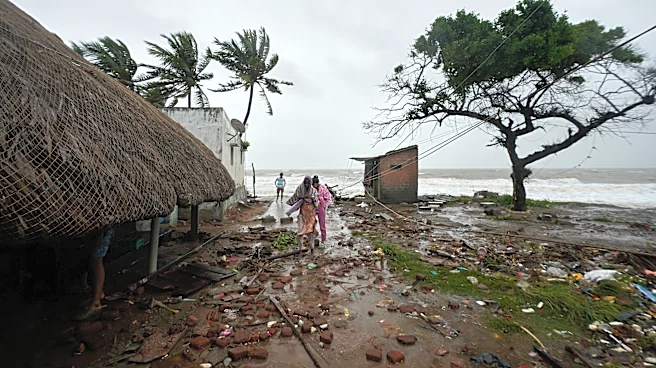








What's Happening?
Cyclone Arnab is projected to make landfall along India's Andhra Pradesh coast on October 28 as a 'very severe cyclonic storm.' The India Meteorological Department (IMD) reports that the storm is moving west-northwestwards and is expected to cross the Andhra Pradesh and Yanam
coasts between Bapatla and Visakhapatnam, near Yanam, before noon on October 28. It is forecast to have maximum sustained wind speeds of 125–135 km/h, gusting to 150 km/h at landfall. The storm underwent rapid intensification, with wind speeds increasing by 74 km/h in the 24 hours leading up to October 27, reaching peak intensity with sustained winds of 150–160 km/h, gusting to 180 km/h, though the IMD anticipates some weakening before landfall. The United States Navy's Joint Typhoon Warning Center (JTWC) has estimated significantly higher wind speeds for Cyclone Arnab, reporting sustained winds of 213 km/h with gusts up to 259 km/h, and forecasting potential further strengthening. Additionally, weather models suggest the possibility of a second cyclonic system developing over the Bay of Bengal and heading towards Odisha shortly after Arnab's landfall, though experts caution that these forecasts remain uncertain.
Why It's Important?
The impending landfall of Cyclone Arnab poses a significant threat to the coastal regions of Andhra Pradesh, with potential for widespread damage and disruption. The 'very severe cyclonic storm' classification indicates a high risk of destruction to infrastructure, particularly thatched houses, and could lead to localized flooding and the uprooting of power and communication poles. This will likely result in substantial economic losses for the affected areas, impacting local businesses, agriculture, and daily life. The potential for 'widespread damage' to standing crops could severely affect the livelihoods of farmers and contribute to food insecurity in the region. Furthermore, the uncertainty surrounding a possible second cyclone developing in the Bay of Bengal adds another layer of concern, suggesting a prolonged period of vulnerability for coastal communities. The discrepancy in wind speed estimates between the IMD and the JTWC highlights the challenges in accurately predicting the intensity of such weather events, which can impact preparedness and response efforts. The U.S. Navy's involvement in tracking the cyclone underscores the international interest and potential for broader humanitarian and disaster relief considerations, though the immediate impact is localized to India.
What's Next?
Authorities in Andhra Pradesh and surrounding regions will continue to monitor Cyclone Arnab's trajectory and intensity as it approaches landfall on October 28. Evacuation orders and emergency preparedness measures will remain in effect, with a focus on minimizing casualties and protecting vulnerable populations. The India Meteorological Department (IMD) will provide continuous updates on the storm's movement and any changes in its forecast. Following landfall, immediate efforts will shift towards search and rescue operations, damage assessment, and the provision of humanitarian aid to affected communities. Restoration of power, communication, and transportation infrastructure will be a priority. Concurrently, meteorologists will closely watch the Bay of Bengal for the potential development of a second cyclonic system, as indicated by some weather models. If a second storm materializes, it would necessitate renewed preparedness efforts and could exacerbate the challenges faced by regions already recovering from Cyclone Arnab. The differing forecasts from the IMD and the JTWC will likely lead to ongoing analysis and refinement of meteorological models to improve future predictions of cyclone intensity.
Beyond the Headlines
The recurring threat of severe cyclonic storms in the Bay of Bengal, exemplified by Cyclone Arnab and the potential for a subsequent system, highlights the broader implications of climate patterns on coastal communities. The 'rapid intensification' observed in Cyclone Arnab underscores a growing concern among climate scientists about the increasing frequency and intensity of extreme weather events, potentially linked to global climate change. This trend places immense pressure on disaster management agencies and local governments to enhance their resilience strategies, including early warning systems, robust infrastructure development, and effective evacuation protocols. The economic and social disruption caused by such events can have long-lasting effects, perpetuating cycles of poverty and displacement in vulnerable regions. Furthermore, the involvement of international agencies like the U.S. Navy's Joint Typhoon Warning Center in tracking these storms points to the global interconnectedness of climate-related challenges and the need for international cooperation in disaster preparedness and response. The long-term implications extend to sustainable development goals, as repeated natural disasters can undermine progress in poverty reduction, health, and education.