





What's Happening?
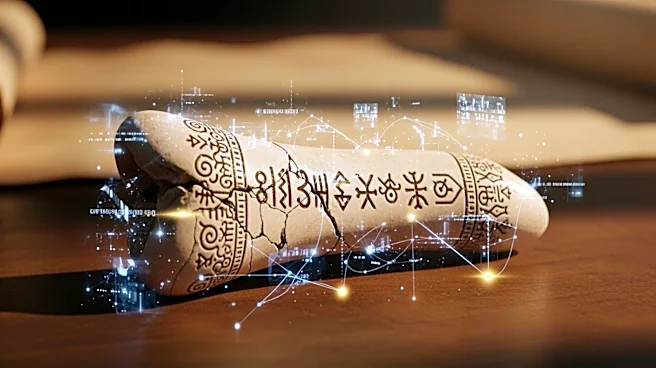
Recent developments in the processing of Oracle bone inscriptions (OBI) have been significantly influenced by the integration of large language models (LMMs) and deep convolutional neural networks (DCNNs). These technologies have transitioned the field
from manual, expert-driven methods to automated frameworks, enhancing tasks such as character recognition, classification, and retrieval. The OracleAgent system exemplifies this shift by providing structured management and retrieval of OBI-related data. This system utilizes multiscale feature integration to align features across different domains, facilitating cross-modal retrieval. The advancements have also led to the creation of large-scale OBI databases, which are crucial for further research and analysis.
Why It's Important?
The integration of advanced AI technologies in OBI processing represents a significant leap in historical data management. By automating complex tasks, these technologies reduce the reliance on expert knowledge, making the field more accessible and efficient. This can lead to more comprehensive and accurate historical analyses, benefiting researchers and historians. The ability to manage and retrieve data more effectively also supports the preservation of cultural heritage, as it allows for better documentation and understanding of ancient texts. Furthermore, these advancements could inspire similar applications in other fields of historical and archaeological research, potentially revolutionizing how ancient data is processed and interpreted.