
What's Happening?
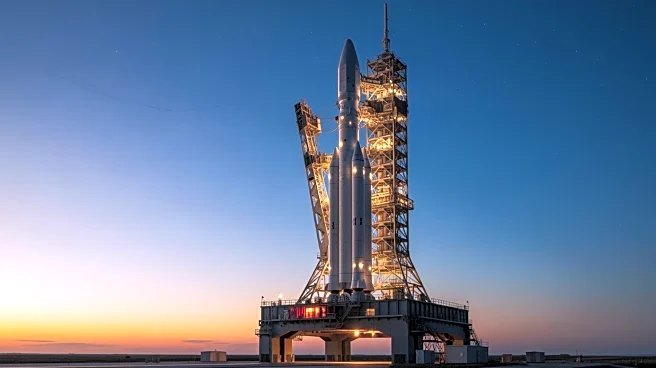
NASA has moved the Artemis 2 moon rocket from the Vehicle Assembly Building to its designated launch pad at Kennedy Space Center. This marks a significant step in the preparation for the first crewed mission
to the moon since the Apollo program ended in 1972. The Artemis 2 mission, scheduled for launch as early as February, will involve a four-person crew flying on the Space Launch System (SLS) and Orion spacecraft. The mission is designed as a 10-day trip that will loop around the moon and return to Earth, serving as a test flight to validate the safety and functionality of the Orion spacecraft and its support systems. The crew includes NASA astronauts Reid Wiseman, Victor Glover, Christina Koch, and Canadian Space Agency astronaut Jeremy Hansen.
Why It's Important?
The rollout of the Artemis 2 rocket is a pivotal moment in NASA's efforts to return humans to the moon, marking the transition from assembly to the launch campaign. This mission is crucial for testing the human factors and systems that cannot be fully simulated on Earth, such as life support and emergency procedures. Successful execution of Artemis 2 will validate the systems needed for future lunar exploration, potentially paving the way for sustained human presence on the moon. This mission also represents international collaboration, with the inclusion of a Canadian astronaut, highlighting the global interest in lunar exploration.
What's Next?
Following the rollout, NASA will conduct a wet dress rehearsal on February 2, where the teams will load cryogenic propellants and run through countdown operations without the astronauts onboard. This rehearsal is designed to identify any real-world issues that may arise during fueling and countdown. If Artemis 2 performs as expected, it will set the stage for future Artemis missions, including potential lunar landings and the establishment of a sustainable human presence on the moon.