



What's Happening?
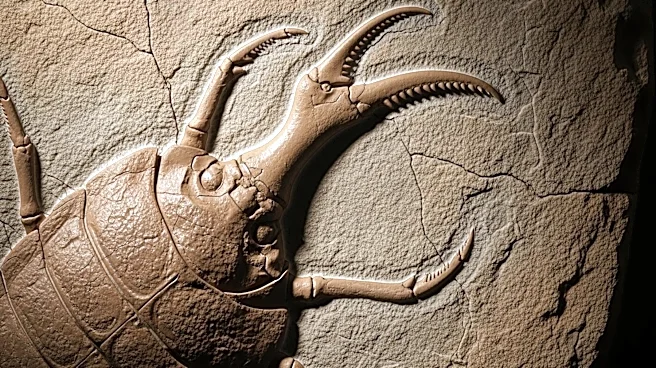
A recent study published in Nature reveals the discovery of a 500-million-year-old sea predator, Megachelicerax cousteaui, in Utah's West Desert. This ancient arthropod is the oldest known chelicerate, a group that includes modern spiders, scorpions,
and horseshoe crabs. The fossil, meticulously cleaned and studied by researchers Rudy Lerosey-Aubril and Javier Ortega-Hernández from Harvard University, shows that the anatomical blueprint of chelicerates was already forming during the Cambrian period. The discovery pushes the evolutionary history of chelicerates back by 20 million years, providing new insights into the early development of these species.
Why It's Important?
The discovery of Megachelicerax cousteaui is significant as it provides a deeper understanding of the evolutionary history of chelicerates, a group that plays a crucial role in both terrestrial and aquatic ecosystems today. By revealing that key anatomical features of chelicerates were already present 500 million years ago, this finding challenges previous assumptions about the timeline of arthropod evolution. It highlights the complexity of Cambrian ecosystems and the rapid pace of evolutionary innovation during that period. This research not only enriches our knowledge of ancient life forms but also informs current biological and ecological studies.