


What's Happening?
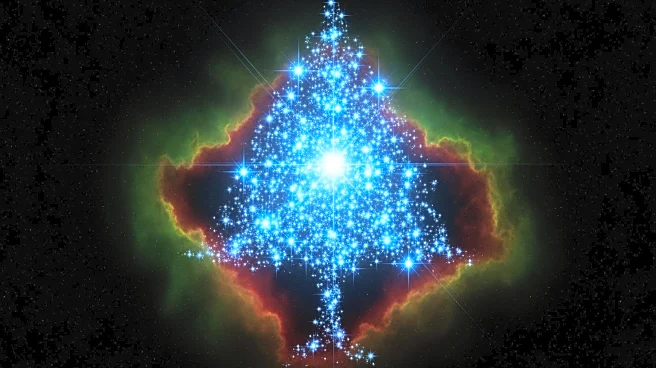
NASA has identified a celestial formation known as the 'Christmas Tree Cluster,' officially designated as NGC 2264, located 2,500 light-years away in the Milky Way galaxy. This cluster is a collection of young stars, ranging from one to five million years old,
which are considered newborns in cosmic terms. The stars vary in size, with some being less than a tenth of the Sun's mass, while others are up to seven times more massive. The cluster's festive appearance is a result of a composite image created using data from NASA's Chandra X-ray Observatory, which highlights the blue and white 'lights' of the young stars, and optical data from the National Science Foundation's WIYN telescope, which shows the green gas of the surrounding nebula. This nebula forms the 'pine needles' and boughs of the tree, while infrared data fills in the stars, creating the impression of a tree against a starry sky.
Why It's Important?
The discovery and imaging of the Christmas Tree Cluster provide valuable insights into the early stages of stellar development. These young stars are undergoing significant changes, including powerful flares caused by magnetic field activity, similar to solar flares but more intense. Understanding these processes is crucial for astronomers studying star formation and the evolution of galaxies. The cluster's proximity, in astronomical terms, allows scientists to observe these phenomena in detail, contributing to our knowledge of the universe's dynamic nature. Additionally, the imagery serves as a reminder of the universe's vastness and the ongoing cosmic events that occur beyond our planet, inspiring both scientific inquiry and public interest in space exploration.
What's Next?
NASA and other space agencies will continue to monitor and study the Christmas Tree Cluster and similar formations to gain further understanding of star formation and evolution. The Chandra X-ray Observatory and other telescopes will likely continue to capture and release new images and data, enhancing our comprehension of these cosmic phenomena. As technology advances, future missions may provide even more detailed observations, potentially leading to new discoveries about the life cycles of stars and the structure of our galaxy.
Beyond the Headlines
The Christmas Tree Cluster's discovery highlights the intersection of science and culture, as it coincides with the holiday season, drawing parallels between cosmic phenomena and human traditions. This connection underscores the role of astronomy in broadening our perspective of the universe and fostering a sense of wonder and curiosity. The cluster's enduring presence, shining for millions of years, contrasts with the transient nature of human celebrations, offering a poignant reminder of the universe's timeless beauty.