






What's Happening?
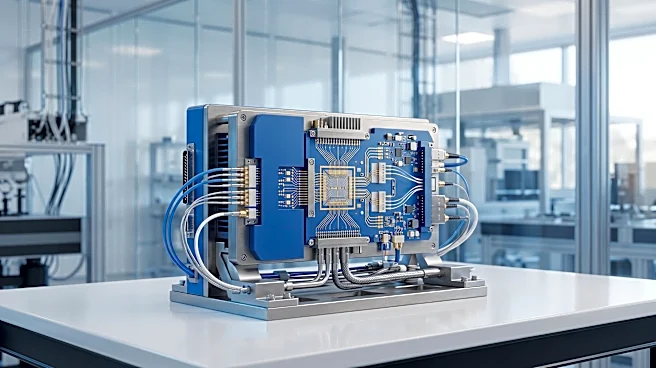
The Perimeter Institute reports significant advancements in quantum error correction, moving quantum computing closer to practical application after three decades of incremental progress. Michele Mosca, a professor at the University of Waterloo’s Institute for
Quantum Computing and a founding member of Perimeter, initially doubted the feasibility of quantum computing due to the inherent fragility of quantum systems and the difficulty of error correction. However, the emergence of viable error correction techniques marked a 'conceptual leap,' shifting the field from impossible to almost impossible. Unlike classical bits, qubits exist in a superposition of states, making them highly susceptible to environmental noise. Quantum error correction methods address this by detecting errors without directly observing the qubit's state, which would destroy its superposition. Researchers use the Bloch sphere to visualize qubit states and identify errors by recognizing shifts into different subspaces, rather than simple bit flips. This interdisciplinary effort, combining physics, mathematics, and quantum matter expertise, is crucial for developing robust quantum systems.
Why It's Important?
The breakthroughs in quantum error correction are critical for the scalability and practicality of quantum computers, which hold the potential to revolutionize various sectors. Quantum computers promise significantly faster calculation speeds, capable of solving problems intractable for even the most advanced classical machines. This advancement also poses a substantial threat to current internet security, as quantum computers could quickly and easily break existing encryption methods. The development of a 'Quantum Valley' in Waterloo Region, driven by industry and investor excitement, underscores the economic and strategic importance of this technology. The ability to maintain the integrity of quantum states despite environmental noise is fundamental to realizing the full potential of quantum computing, impacting fields from medicine and materials science to finance and artificial intelligence. The ongoing need for theoretical contributions and interdisciplinary collaboration highlights the complex challenges and vast opportunities in this evolving field.
What's Next?
The focus for quantum computing development will continue to be on refining error correction codes and improving hardware noise levels to reach a critical threshold for real-world applications. Researchers like Sahu, Xu, and Zhou are actively investigating methods to achieve the Heisenberg limit using fault-tolerant quantum error correction, pushing the boundaries of what is possible. Michele Mosca emphasizes the ongoing need for theoretical contributions to translate technological advancements into practical applications, advocating for interdisciplinary thinking to foster genuine breakthroughs. The convergence of error-correcting codes and topological phases of matter offers a promising avenue for building more robust quantum systems. As hardware becomes more stable and error correction more effective, the next steps involve scaling up quantum computers to tackle increasingly complex problems, potentially leading to new discoveries and technological paradigms.
Beyond the Headlines
The journey of quantum computing from initial skepticism to cautious optimism, as described by Michele Mosca, illustrates a broader scientific principle: perseverance and interdisciplinary collaboration are vital for significant scientific progress. The fundamental incompatibility between quantum mechanics and traditional error correction methods has necessitated ingenious workarounds, such as projective measurement, which allows error detection without collapsing the fragile quantum state. This highlights a deeper philosophical shift in how scientists approach problem-solving when faced with the unique constraints of quantum reality. The no-cloning theorem, which prevents the exact replication of quantum information, has forced researchers to develop entirely new encoding strategies, such as logical qubits, further demonstrating the innovative thinking required. The success of quantum error correction is not just a technical achievement but represents a fundamental shift in humanity's understanding and manipulation of the quantum world, with profound implications for future technological and scientific endeavors.