




What's Happening?
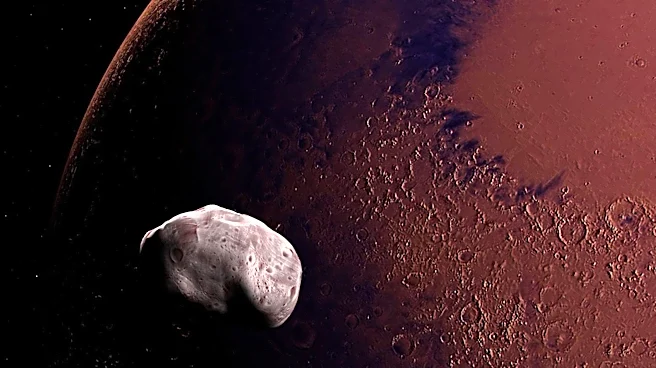
Phobos, Mars' larger moon, orbits the planet more than three times per Martian day, rising in the west and setting in the east. This unusual orbit is due to Phobos moving faster than Mars' rotation. The moon completes an orbit in 7 hours and 39.2 minutes,
while a Martian day lasts about 24 hours and 39 minutes. This makes Phobos one of the few moons in the solar system with an orbital period shorter than its planet's day. Its proximity to Mars and rapid orbit provide valuable data for understanding the planet's tidal dynamics and internal structure.
Why It's Important?
Phobos' orbit offers a unique opportunity to study tidal interactions between a planet and its moon. The moon's inward spiral, caused by tidal forces, provides insights into Mars' internal structure and energy dissipation. Understanding these dynamics is crucial for planetary science, as it helps scientists model the evolution of planetary systems. Additionally, Phobos' behavior serves as a natural laboratory for studying tidal interactions, which can be applied to other celestial bodies.
What's Next?
The Japanese Martian Moons eXploration (MMX) mission aims to further study Phobos and Deimos, Mars' moons. Scheduled for launch in 2026, the mission will collect samples from Phobos and return them to Earth by 2031. This mission could provide direct evidence of Phobos' origin, whether it is a captured asteroid or formed from debris after a large impact on Mars. The data collected will enhance our understanding of Mars' history and the processes shaping its moons.