





What's Happening?
Researchers at the University of Tokyo have introduced a groundbreaking microscopy technique that uncovers a previously invisible layer of biomolecular chemistry influenced by weak magnetic fields. Led by Project Researcher Noboru Ikeya and Professor
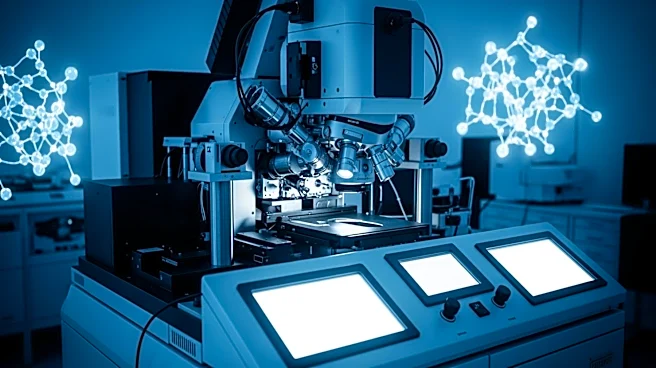
Jonathan R. Woodward, the team developed a method called pump-field-probe fluorescence microscopy. This technique uses two timed light pulses combined with a synchronized magnetic pulse to track changes in molecular signals, isolating spin-dependent reactions. The approach allows scientists to directly observe molecular processes that were previously inferred indirectly, offering new insights into how weak magnetic fields affect biological systems. The technique has been validated using flavin-based model systems, demonstrating high sensitivity even at low concentrations similar to those found in cells. This advancement connects fluorescence microscopy with spin chemistry, potentially advancing quantum biology and supporting noninvasive diagnostic methods.
Why It's Important?
The development of this microscopy technique is significant as it provides a new way to study molecular processes that were previously difficult to observe. By revealing how weak magnetic fields influence biomolecular chemistry, the technique could lead to advancements in quantum biology and the development of noninvasive diagnostic methods. This has implications for understanding biological systems at a molecular level, potentially leading to new treatments and technologies in the life sciences. The ability to measure reaction lifetimes and magnetic responses with high sensitivity opens up new possibilities for research in live-cell studies, offering a practical path for studying magnetic effects at the molecular scale.
What's Next?
The research team plans to apply the microscopy platform to more complex biological environments and improve analysis methods for separating overlapping reaction pathways. By making short-lived, non-emissive intermediates accessible to experiments, the technique expands what can be measured in biological photochemistry. This could lead to further advancements in understanding molecular interactions and developing new diagnostic and therapeutic approaches. The ongoing research aims to refine the technique for broader applications in life sciences, potentially transforming how scientists study and manipulate molecular processes.