







What's Happening?
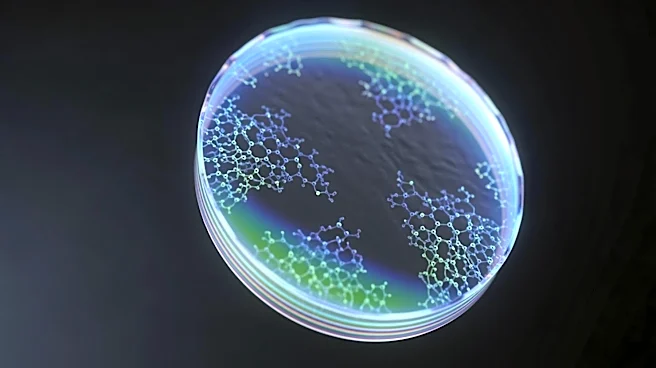
Scientists at Scripps Research Institute, in collaboration with IAVI and other institutes, have developed a nanodisc platform that offers a clearer view of how key viral proteins interact with antibodies. This innovative approach utilizes nanodisc technology,
embedding viral surface proteins into lipid molecules to preserve them in a membrane-like structure. The platform was tested using proteins from HIV and Ebola, aiming to improve vaccine research by revealing how antibodies and viral proteins interact. The nanodiscs mimic the virus's outer layer, helping preserve how antibodies identify proteins in an actual virus. This method allows researchers to use standard vaccine-development tools, including tests of antibody binding and high-resolution imaging, to better understand how protective antibodies recognize a virus.
Why It's Important?
The development of the nanodisc platform is significant as it addresses a longstanding challenge in vaccine design: the difficulty in studying viral proteins in their natural membrane context. By providing a more realistic environment for these proteins, the platform enhances the understanding of how antibodies neutralize viruses, potentially leading to more effective vaccines. This advancement is particularly crucial for viruses like HIV and Ebola, which have complex surface proteins that are difficult for the immune system to target. The platform's ability to capture detailed structural snapshots of antibody interactions offers insights that could inform the design of next-generation vaccines, improving public health outcomes and advancing research in immunology.
What's Next?
The nanodisc platform is expected to be applied broadly to other viruses with similar membrane-embedded proteins, such as influenza and SARS-CoV-2. Researchers plan to use the platform to analyze immune responses to vaccine candidates, providing a clearer picture of how the body responds to different designs. The system's scalability allows for rapid preparation and comparison of multiple candidate designs, accelerating vaccine research. While the platform itself is not a vaccine, it serves as a tool to inform and advance vaccine development, particularly for viruses where traditional approaches have been less effective.
Beyond the Headlines
The nanodisc platform represents a shift in how viral proteins are studied, offering a more accurate method for testing vaccine candidates early in the development process. This could lead to ethical considerations regarding the prioritization of vaccine research and the allocation of resources. Additionally, the platform's ability to provide detailed insights into antibody interactions may influence future research directions in immunology, potentially leading to breakthroughs in understanding immune responses to various pathogens.