





What's Happening?
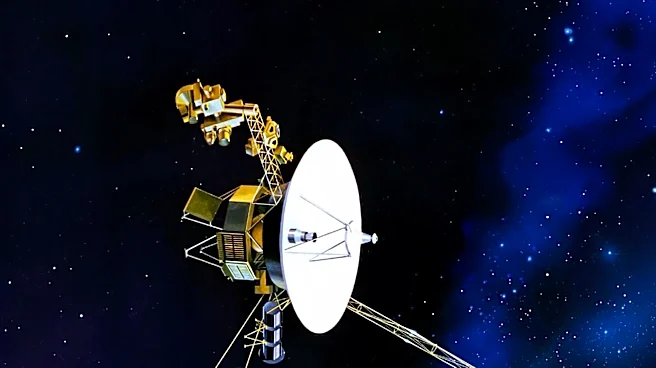
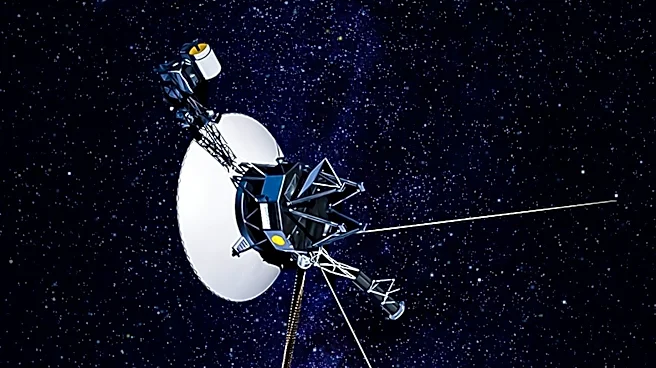
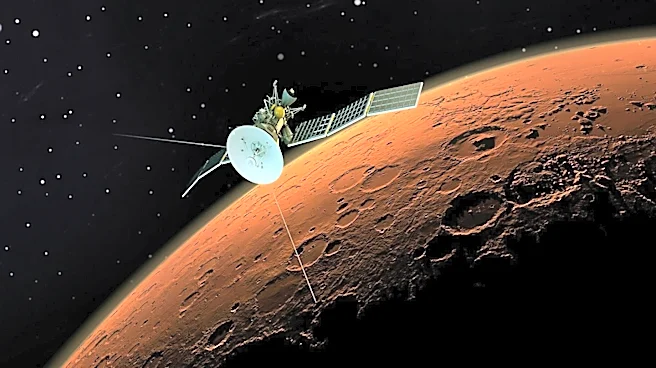
NASA's Voyager 1 and 2, launched in 1977, were initially designed for a five-year mission to explore Jupiter and Saturn. However, nearly 49 years later, both probes remain operational and continue to transmit data from beyond the heliosphere, marking
them as the only human-made objects in interstellar space. The mission, managed by NASA and operated by the Jet Propulsion Laboratory, has exceeded its original scope due to a rare planetary alignment that allowed the spacecraft to use gravitational assists to extend their journey. Voyager 1 crossed the heliopause in 2012, followed by Voyager 2 in 2018, enabling them to measure the interstellar environment directly. Despite the challenges of diminishing power from their radioisotope thermoelectric generators, the mission team has managed to keep the probes operational by shutting down non-essential systems and instruments.
Why It's Important?
The continued operation of the Voyager probes provides invaluable data about the interstellar medium, contributing to our understanding of the solar system's boundary and the broader galaxy. This mission exemplifies human ingenuity and the potential for long-term space exploration, offering insights that could inform future missions beyond our solar system. The data collected by the Voyagers help scientists understand cosmic rays, magnetic fields, and the heliosphere's structure, which are crucial for planning future interstellar missions. The mission also highlights the importance of international collaboration and sustained investment in space exploration, as the knowledge gained extends beyond national borders and benefits the global scientific community.
What's Next?
NASA anticipates that the Voyager probes will continue to operate into the 2030s, although unexpected technical issues could end the mission sooner. The mission team is focused on maximizing the remaining power to maintain communication and data collection. As the probes venture further into interstellar space, they will continue to provide unique scientific data, potentially leading to new discoveries about the universe. The mission's success may inspire future interstellar missions, leveraging lessons learned from Voyager's longevity and adaptability.