
What's Happening?
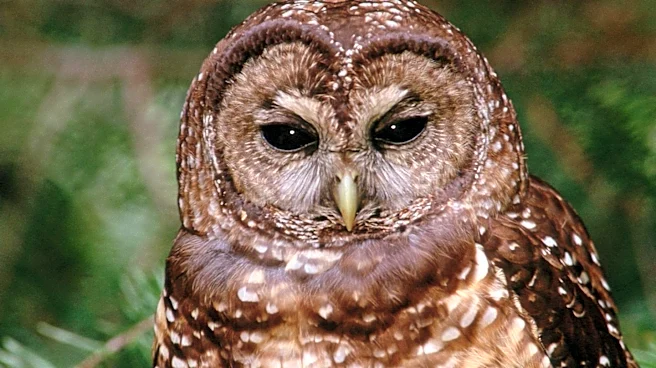
Green Diamond Resource Company, a California-based forestry and timber company, is actively participating in the conservation and re-establishment of the northern spotted owl species. The company's land
near Korbel, California, has been a site for observing these owls. While thousands of northern spotted owls still exist in the U.S., their population in Canada is nearly non-existent. Conservation efforts in British Columbia, Canada, include a breeding program that aims to reintroduce captive-bred owls into the wild. This program has faced challenges, with some released birds not surviving. The species' habitat spans from the Lower Mainland in Canada down through Washington state, Oregon, and northern California. The primary threats to the northern spotted owl are habitat loss due to logging and competition from barred owls.
Why It's Important?
The involvement of companies like Green Diamond Resource Company in conservation highlights the growing intersection of industry and environmental stewardship. The northern spotted owl is an indicator species for the health of old-growth forests, and its decline signals broader ecological issues. Conservation efforts in the U.S. are crucial as they represent a significant portion of the remaining wild population, potentially serving as a source for re-establishment in other regions. The challenges faced by breeding programs, such as the mixed success of reintroducing captive-bred owls, underscore the complexity and difficulty of species recovery. The competition with barred owls also points to the impact of invasive or more adaptable species on native wildlife, necessitating management strategies like culling, as seen in a U.S. plan to reduce barred owl populations.
What's Next?
Future efforts will likely focus on continuing breeding and reintroduction programs, refining release strategies to improve survival rates of captive-bred owls. In the U.S., the plan to cull over 350,000 barred owls over 30 years will proceed, aiming to reduce competition for the northern spotted owl. Conservationists will also continue to advocate for the protection and restoration of old-growth forests, which are critical habitats for the species. Collaboration between government agencies, Indigenous communities, and private landowners like Green Diamond Resource Company will be essential to ensure the long-term viability of the northern spotted owl population. The success of these initiatives in the U.S. could provide valuable lessons for similar efforts in Canada and other regions.
Beyond the Headlines
The plight of the northern spotted owl, and the efforts by entities like Green Diamond Resource Company to conserve it, reflects a broader societal debate about balancing economic activities, such as timber harvesting, with environmental protection. The species' reliance on old-growth forests brings into focus the long-term ecological consequences of deforestation and habitat fragmentation. The competition with barred owls also raises ethical questions about human intervention in natural ecosystems, particularly regarding population control measures like culling. This situation underscores the interconnectedness of ecosystems and the ripple effects of human actions, prompting a re-evaluation of sustainable resource management and biodiversity preservation strategies in the face of climate change and habitat loss.