



What's Happening?
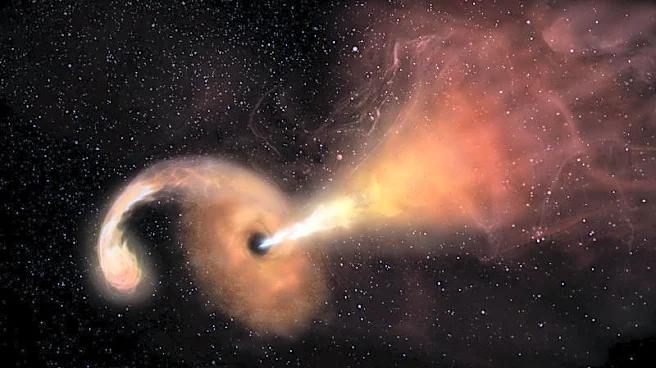
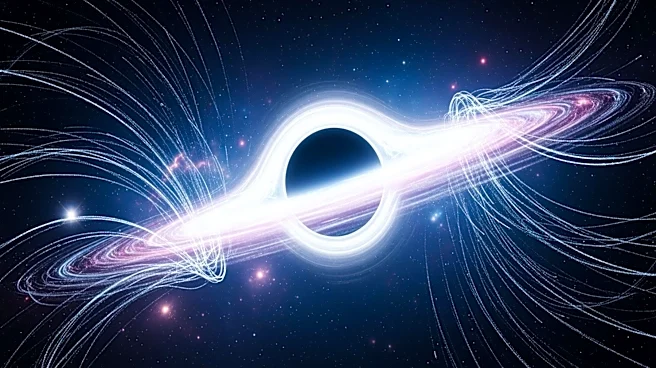
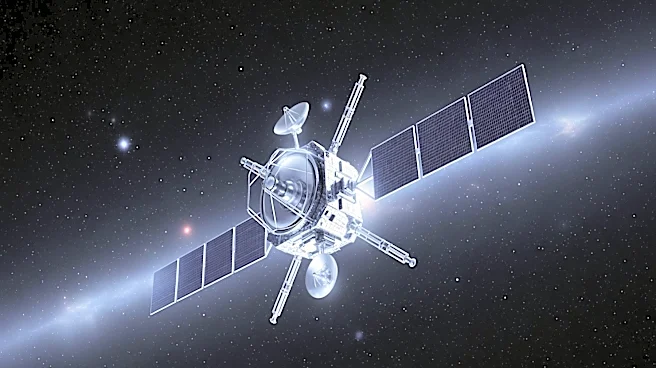
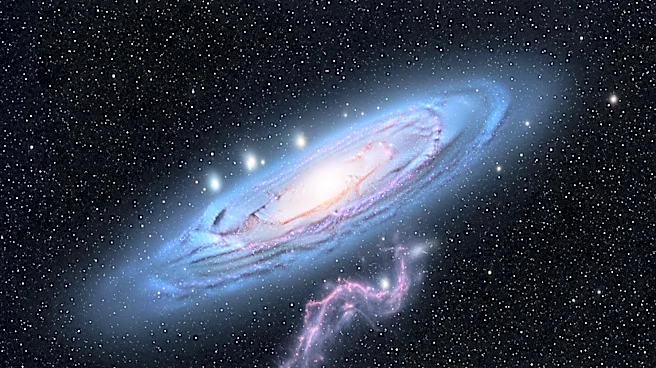
Astronomers have observed, for the first time, a powerful wind emanating from Sagittarius A*, the supermassive black hole at the center of the Milky Way galaxy. This discovery was made using data from the Atacama Large Millimeter/Submillimeter Array (ALMA)
and NASA's Chandra X-ray Observatory. The team, led by Mark Gorski and Elena Murchikova, found that the wind is not particularly powerful and its direction changes over time. This finding provides a new perspective on how black holes interact with their environments, challenging the notion that they are merely cosmic vacuum cleaners. The study reveals that even a small amount of gas falling into a black hole can generate enough energy to push material outward, forming winds or jets.
Why It's Important?
The detection of wind from Sagittarius A* is significant as it offers insights into the behavior of supermassive black holes, which are typically difficult to observe due to their quiet phases. Understanding these winds can help scientists learn more about the role of black holes in galaxy formation and evolution. The discovery also highlights the non-unique nature of our galaxy's central black hole, suggesting that similar processes may occur in other galaxies. This research could lead to a better understanding of the life cycles of black holes and their impact on the surrounding cosmic environment.
What's Next?
The research team plans to continue analyzing the data to further understand the dynamics of the wind and its effects on the surrounding environment. Future observations may focus on identifying similar phenomena in other galaxies, which could provide comparative data to enhance our understanding of black hole behavior. Additionally, the findings may prompt further theoretical studies to explore the mechanisms behind wind generation in black holes.