







What's Happening?
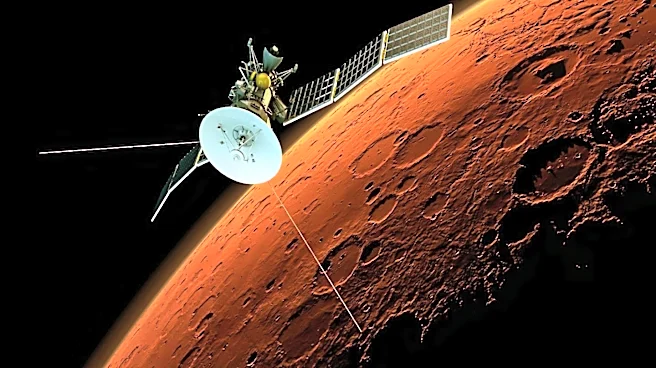
NASA's Viking Project marked a significant milestone in space exploration as the first U.S. mission to land a spacecraft on Mars and search for signs of life. Launched in the mid-1970s, the mission consisted of two spacecraft, each with an orbiter and a lander.
Viking 1 landed on Mars on July 20, 1976, followed by Viking 2 on September 3, 1976. These landers conducted experiments to detect life, revealing unexpected chemical activity in the Martian soil, though no definitive evidence of life was found. The mission provided extensive data, including over 52,000 photographs from orbit and 4,500 from the surface, mapping 97% of Mars and offering the first digital images from the Martian surface.
Why It's Important?
The Viking Project was groundbreaking in its approach to astrobiology, setting the stage for future Mars exploration. It demonstrated the feasibility of landing on and studying Mars, influencing subsequent missions and the development of life detection strategies. The mission's findings on Martian soil chemistry and atmospheric conditions have been crucial for understanding Mars' environment and potential habitability. The data collected continues to inform NASA's astrobiology research and the design of instruments for future missions, highlighting the importance of interdisciplinary collaboration in space exploration.
What's Next?
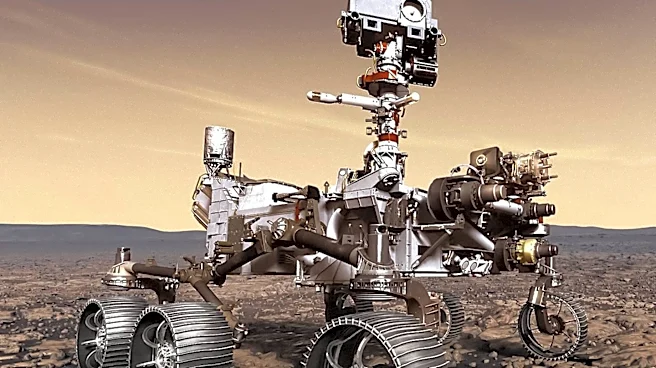
The legacy of the Viking Project continues to shape NASA's exploration strategies. Current and future missions, such as the Perseverance rover, build on Viking's foundation, employing advanced technology to search for signs of past life and prepare for human exploration. The insights gained from Viking's experiments guide the development of new instruments and methodologies for detecting life on Mars and other celestial bodies. As NASA plans for manned missions to Mars, the lessons from Viking remain integral to ensuring mission success and safety.
Beyond the Headlines
The Viking Project's impact extends beyond scientific discoveries, influencing public perception and interest in space exploration. It underscored the challenges of interplanetary missions and the need for robust scientific inquiry. The mission also highlighted the importance of international collaboration, as scientists worldwide continue to analyze Viking's data. The ethical considerations of searching for extraterrestrial life, initiated by Viking, remain relevant as humanity contemplates its place in the universe and the potential implications of discovering life beyond Earth.