
What's Happening?
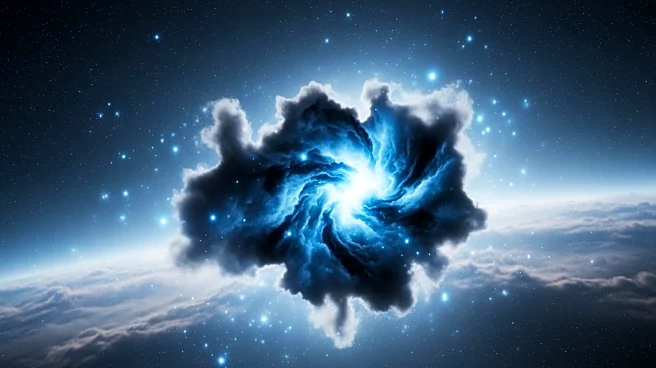
NASA's Hubble Space Telescope has identified a new type of astronomical object, a starless, gas-rich, dark-matter cloud named 'Cloud-9'. This discovery marks the first confirmed detection of such an object, which
is considered a relic from early galaxy formation. The object, known as a Reionization-Limited H I Cloud (RELHIC), is composed of neutral hydrogen and is about 4,900 light-years in diameter. It was initially discovered through a radio survey by the Five-hundred-meter Aperture Spherical Telescope (FAST) in China and later confirmed by the Green Bank Telescope and the Very Large Array in the United States. The findings were presented at the 247th meeting of the American Astronomical Society in Phoenix and published in The Astrophysical Journal Letters.
Why It's Important?
The discovery of Cloud-9 provides significant insights into the early universe and the nature of dark matter. As a dark-matter-dominated cloud that has not formed stars, it offers a unique opportunity to study the intrinsic properties of dark matter, which constitutes most of the universe's mass but is difficult to detect. This finding suggests the existence of many other small, dark matter-dominated structures, or 'failed galaxies', which could reshape our understanding of galaxy formation and the dark components of the universe. The study of such objects could lead to breakthroughs in understanding the physics of dark matter and the conditions of the early universe.
What's Next?
Future surveys and observations are expected to enhance the discovery of more 'failed galaxies' or 'relics', providing further insights into the early universe and dark matter. The Hubble Space Telescope, a collaboration between NASA and the European Space Agency, continues to play a crucial role in these discoveries. As technology advances, more detailed studies of these dark matter clouds could reveal new aspects of cosmic evolution and the formation of galaxies.
Beyond the Headlines
The identification of Cloud-9 challenges traditional observational methods that focus on bright objects like stars and galaxies. It highlights the importance of studying gas and dark matter to gain a complete understanding of cosmic systems. The rarity of such objects and their potential vulnerability to environmental effects like ram-pressure stripping underscore the need for advanced observational techniques. This discovery also raises questions about the future evolution of such clouds and their potential to form galaxies under certain conditions.