




What's Happening?
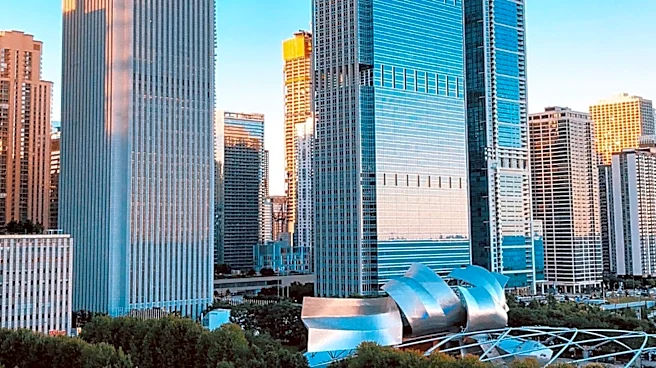
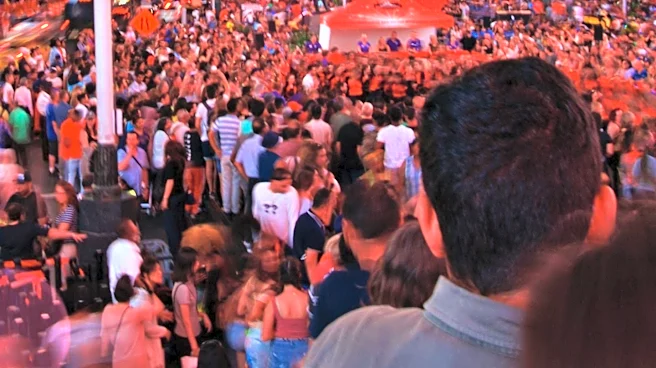
Hundreds of individuals convened in downtown Chicago's Millennium Park on Sunday, participating in a viral social media event aimed at attempting to move 'The Bean' (officially known as Cloud Gate, a sculpture by Anish Kapoor) seven inches to the left.
The gathering was spurred by flyers distributed downtown and an internet rumor suggesting a man was trapped inside the 110-ton stainless steel sculpture. Participants believed that moving the sculpture would free this hypothetical individual. Despite the significant turnout, the group was unsuccessful in displacing the massive art installation. This event follows previous satirical claims and protests in 2025 related to the 'man in the bean' folklore, which even prompted a response from Gov. JB Pritzker and inspired a mockumentary titled 'Man in the Bean' released earlier this year on YouTube.
Why It's Important?
This event highlights the significant influence of social media and internet folklore in mobilizing public gatherings, even for satirical or physically impossible objectives. The viral nature of the 'man in the bean' rumor demonstrates how online narratives can transcend digital spaces and manifest in real-world actions, drawing hundreds of people to a public landmark. It also underscores the cultural impact of public art, as 'The Bean' has become a focal point for both genuine appreciation and whimsical internet-driven phenomena. The participation of a large crowd, despite the clear impossibility of the task, reflects a collective engagement with humor and shared online culture, showcasing a unique form of community interaction in urban settings. This phenomenon can also be seen as a form of performance art, where the act of gathering and attempting the impossible becomes the event itself, rather than the achievement of the stated goal.
What's Next?
While the immediate objective of moving 'The Bean' was not achieved, the event's success in drawing a large crowd suggests that similar social media-driven gatherings around public landmarks or cultural phenomena could occur in the future. The ongoing nature of internet folklore means that the 'man in the bean' narrative, or similar whimsical stories, may continue to evolve and inspire further public engagement. Local authorities and park management may need to consider strategies for managing large, impromptu gatherings spurred by online trends, especially when they involve public art or infrastructure. The event also serves as a case study for understanding how digital culture can influence physical spaces and community behavior, potentially leading to more organized or themed events in response to viral content.
Beyond the Headlines
The 'Push The Bean' event delves into the broader implications of collective action in the digital age, where the line between irony and genuine belief can blur. It raises questions about the nature of public engagement with urban spaces and iconic landmarks, transforming them from static objects into dynamic stages for internet-fueled narratives. The event also touches upon the psychological aspects of crowd behavior and the power of shared humor or belief, however fantastical, to unite people. Ethically, it prompts consideration of how public spaces are used and potentially impacted by such large-scale, unconventional gatherings. Culturally, it reinforces 'The Bean's' status not just as a piece of art, but as a living part of Chicago's identity, capable of inspiring both admiration and playful, community-driven antics.