







What's Happening?
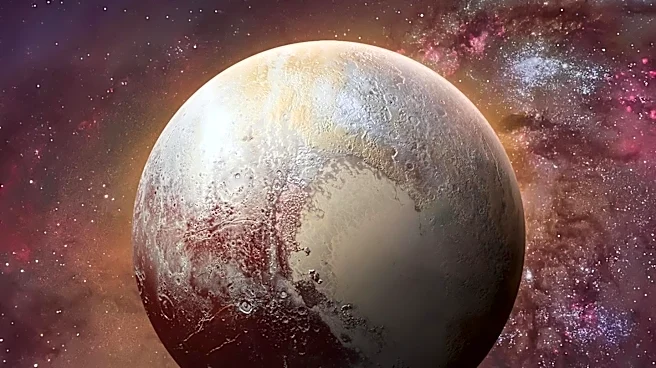
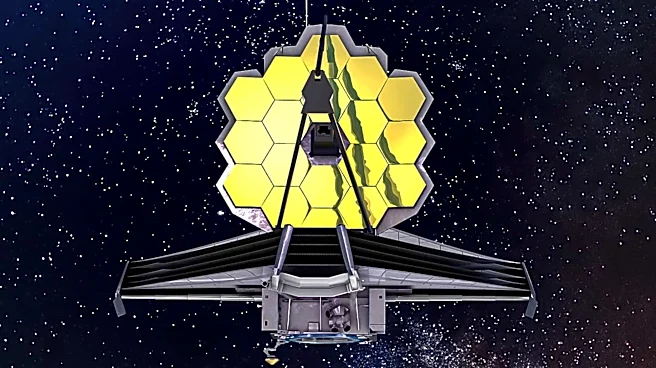
The James Webb Space Telescope has identified an unexplained absorption signal on the surfaces of Pluto and Titan, two celestial bodies with distinct environments but a shared methane-and-nitrogen chemistry. This signal, detected at approximately 5.11
micrometres in the mid-infrared spectrum, has not been matched to any known molecule in laboratory settings. The signal appears as a dip in the light spectrum, indicating the presence of a material that absorbs light at this specific wavelength. While the feature is present on both Pluto and Titan, it differs in shape, suggesting a related but not identical material on each world. The discovery is intriguing due to the vastly different characteristics of Pluto and Titan, yet both share a nitrogen-rich atmosphere with methane, which may drive similar chemical processes.
Why It's Important?
This discovery is significant as it highlights the potential for shared chemical processes across different celestial bodies, despite their distinct environments. The presence of a similar absorption feature on both Pluto and Titan suggests that the same type of chemistry might be occurring on both, driven by solar radiation interacting with methane and nitrogen. This could lead to the formation of complex organic molecules, which are of great interest to scientists studying the building blocks of life. The identification of this signal could enhance our understanding of planetary atmospheres and surface compositions, potentially offering insights into the processes that shape them. Furthermore, it underscores the capabilities of the James Webb Space Telescope in advancing our knowledge of the solar system.
What's Next?
Future research will focus on further observations using the James Webb Space Telescope to map the distribution of this signal on Titan, which could reveal its association with specific regions or materials. Additionally, laboratory experiments will be conducted to simulate the conditions on Pluto and Titan, testing various candidate molecules to identify the one responsible for the absorption feature. If a match is found, it would confirm the presence of a specific compound or family of compounds on both worlds, providing a deeper understanding of their chemical processes. This ongoing research will continue to unravel the mysteries of these distant worlds and their potential similarities.