





What's Happening?
Recent research indicates that a 14th-century Arabic text, long considered a factual account of the Black Death's rapid spread from China to the Mediterranean, was misinterpreted. The study, published in the Journal of Arabic and Islamic Studies, focuses
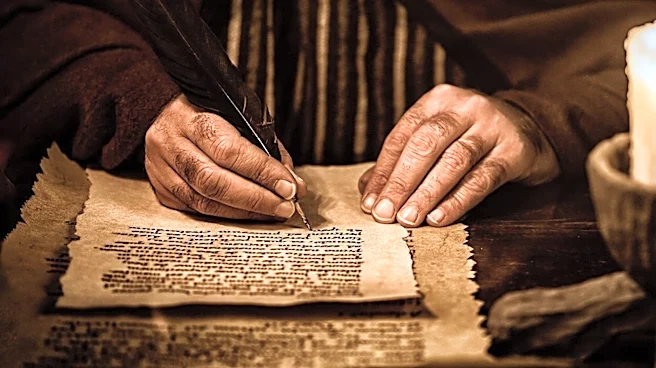
on the 'Risāla' by Syrian writer Ibn al-Wardī, who died during the plague in 1349. Historians previously treated this work as an eyewitness report detailing the disease's path across Asia into the Islamic world. However, lead author Muhammed Omar of the University of Exeter argues that the 'Risāla' was not intended as a historical account but rather as a 'maqāma,' a literary genre characterized by rhymed prose and metaphor. The narrative, which describes the plague as a traveler moving through cities, was a figurative device to help communities cope with the crisis, not a literal record of transmission. This misinterpretation began in the 15th century when Mamluk historians treated the text as fact, an error perpetuated in modern scholarship, notably by historian Michael Dols in the 1970s, whose work supported the theory of a rapid overland spread.
Why It's Important?
This re-evaluation of a key historical source significantly impacts our understanding of one of the most devastating pandemics in human history. The long-held belief in the Black Death's swift overland transmission, partly based on this misread text, has influenced both historical narratives and scientific studies of the plague's origins. By correcting this historical misinterpretation, researchers are prompted to re-examine earlier outbreaks and explore broader patterns of disease transmission, potentially leading to new insights into how pandemics spread. The study highlights the critical importance of contextualizing historical documents, especially literary works, to avoid drawing inaccurate conclusions about past events. This shift in understanding could influence future epidemiological models and historical analyses of disease spread, emphasizing the need for rigorous textual analysis in historical research.
What's Next?
The study's findings call for historians to re-examine existing theories about the Black Death's spread, particularly those relying on the 'Risāla' as a factual historical document. Future research will likely focus on identifying and analyzing other primary sources with a renewed critical lens, distinguishing between literal historical accounts and literary interpretations of events. This could lead to a more nuanced understanding of the plague's geographical progression and the various factors that contributed to its devastating impact. Additionally, the study encourages a deeper exploration of how Islamic scholars used literature to process and respond to crises, moving beyond a purely factual interpretation to appreciate the cultural and emotional dimensions of their writings. This re-evaluation may also prompt a broader discussion within historical and epidemiological communities about the methodologies used to reconstruct past disease outbreaks.
Beyond the Headlines
The reinterpretation of Ibn al-Wardī's 'Risāla' underscores a broader challenge in historical scholarship: the potential for literary devices to be mistaken for factual reporting, especially across different cultural and temporal contexts. This case highlights the ethical responsibility of historians to critically assess sources, considering their genre, authorial intent, and cultural context. The study also sheds light on the resilience of communities in the face of catastrophe, demonstrating how literature served as a vital tool for sense-making, moral reflection, and communal coping during the Black Death. It reveals that historical texts are not merely repositories of facts but also cultural artifacts that reflect the human experience of crisis, offering insights into societal values, beliefs, and coping mechanisms. This deeper understanding enriches our appreciation of medieval Islamic intellectual traditions and their contributions to understanding human responses to pandemics.