








What's Happening?
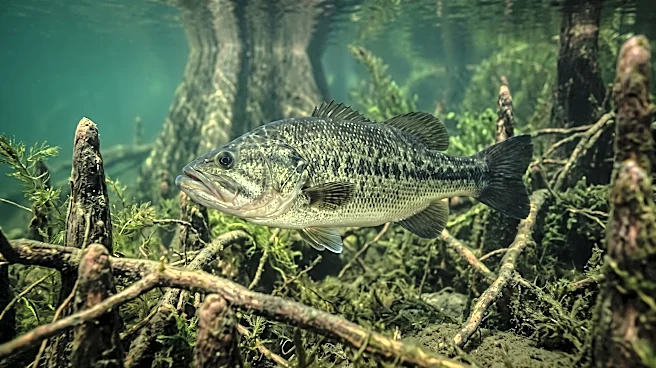
A recent study indicates that largemouth bass, including record-tying specimens like Manabu Kurita's 22-pound, 4-ounce fish, tend to be 'homebodies' with restricted ranges. This finding suggests that these fish do not typically undertake extensive migrations
or movements within their aquatic environments. The research highlights a behavioral pattern where individual bass establish and remain within relatively small territories. This characteristic is observed across various sizes and notable examples of the species, challenging potential assumptions about their mobility. The study's observations contribute to a deeper understanding of largemouth bass ecology and behavior, particularly concerning their spatial distribution and habitat utilization. This sedentary nature implies that local environmental conditions and resource availability within a small area are critical factors influencing their survival and growth.
Why It's Important?
This insight into the limited movement of largemouth bass has significant implications for fisheries management and conservation efforts in the U.S. Understanding that these fish are 'homebodies' means that localized environmental disturbances, such as habitat degradation, pollution, or overfishing in specific areas, can have a disproportionately severe impact on bass populations. If bass do not readily move to new areas, their ability to recover from localized stressors is diminished. For anglers, this information can influence fishing strategies, suggesting that successful fishing may depend more on understanding specific local habitats rather than tracking wide-ranging movements. Conservationists can use this data to advocate for targeted, localized protection measures, emphasizing the importance of preserving specific habitats rather than relying on broader, less focused conservation strategies. This behavioral trait underscores the vulnerability of bass populations to changes within their immediate surroundings.
What's Next?
Future research may delve into the specific factors that define the boundaries of these 'homebody' ranges for largemouth bass, such as food availability, water temperature, depth, and structural cover. This could lead to more precise habitat mapping and management strategies. Fisheries agencies might adjust stocking programs or fishing regulations to account for the localized nature of bass populations, potentially implementing more granular management zones. Anglers might see the development of new techniques or technologies that leverage this understanding of bass behavior, focusing on identifying and exploiting these smaller, established territories. Additionally, conservation groups may use these findings to advocate for stricter protections of critical bass habitats, emphasizing the limited ability of these fish to escape or adapt to localized environmental changes. The study could also prompt further investigation into whether this 'homebody' behavior varies significantly across different geographic regions or water body types.
Beyond the Headlines
The 'homebody' nature of largemouth bass could have broader ecological implications beyond just their species. As a top predator in many freshwater ecosystems, their localized presence means that their impact on prey species and the overall food web is also highly localized. This could lead to distinct ecological niches and community structures within different parts of a single lake or river. Ethically, this finding reinforces the responsibility of human activities to minimize localized environmental impacts, as the affected bass populations may not have the capacity to relocate. Legally, it might support arguments for more stringent environmental impact assessments for projects affecting specific aquatic habitats. Culturally, this understanding could deepen the appreciation for the intricate balance of local ecosystems, highlighting how even seemingly small changes can have significant, contained effects on key species like the largemouth bass, influencing recreational fishing traditions and local economies tied to these fisheries.