
What's Happening?
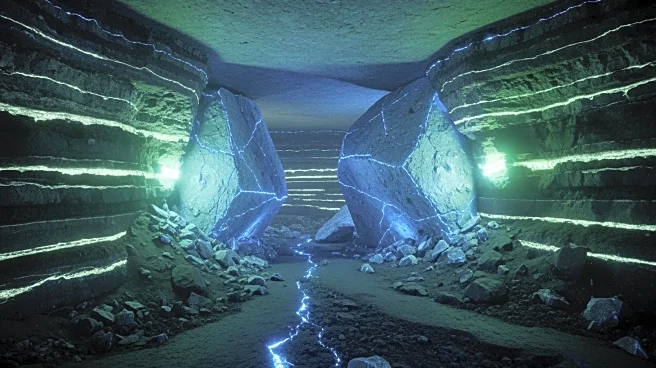
Scientists have identified two massive underground structures beneath Africa, which may be remnants of an ancient planet that collided with Earth billions of years ago. These formations, known as large
low-shear-velocity provinces (LLSVPs), were detected through seismic tomography, a technique that maps Earth's internal structure by analyzing how earthquake waves travel through different materials. The seismic waves slow down significantly when passing through these structures, indicating a distinct composition compared to the surrounding mantle. A leading theory suggests these structures are fragments of Theia, a hypothetical planet believed to have collided with Earth during the giant impact event that formed the Moon. If true, these structures represent a lost planetary body embedded in Earth's mantle for over 4.5 billion years.
Why It's Important?
The discovery of these structures has significant implications for our understanding of Earth's formation and geological history. If these structures are indeed remnants of Theia, it would provide concrete evidence supporting the giant impact hypothesis, which posits that a Mars-sized object collided with Earth, leading to the Moon's formation. This finding could reshape scientific perspectives on planetary formation and the early solar system. Additionally, the presence of these structures may influence Earth's dynamic systems, as they are located near the core-mantle boundary, a region that generates mantle plumes responsible for surface volcanoes. Understanding these structures could offer insights into volcanic activity and tectonic processes, potentially impacting geological research and hazard assessment.
What's Next?
Further research is needed to confirm the origin of these structures and their role in Earth's geological processes. Scientists will likely continue to use advanced seismic imaging techniques and simulations to study these formations. Additionally, researchers may explore alternative explanations, such as the possibility that these structures are accumulated oceanic crust or primordial heterogeneities. The ongoing investigation into these deep-Earth masses could lead to new discoveries about Earth's interior and its geological history, influencing future studies in geophysics and planetary science.
Beyond the Headlines
The potential identification of Theia's remnants within Earth's mantle raises intriguing questions about the nature of planetary collisions and their long-term effects on planetary bodies. This discovery could prompt a reevaluation of how planetary materials are distributed and preserved following such impacts. Moreover, the study of these structures may offer insights into the processes that govern mantle convection and the formation of mantle plumes, which are crucial for understanding volcanic activity and continental drift. The research could also have broader implications for the study of exoplanets and the conditions necessary for planetary formation and stability.