



What's Happening?
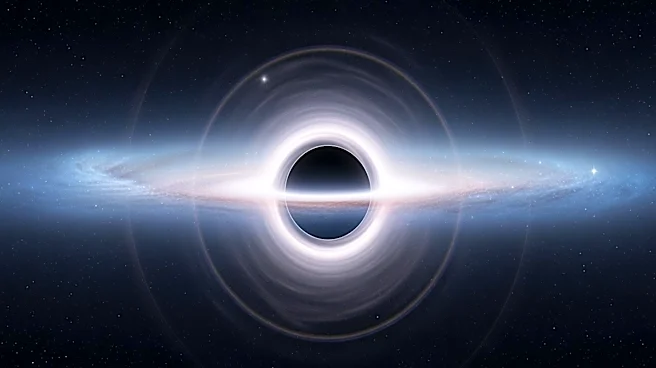
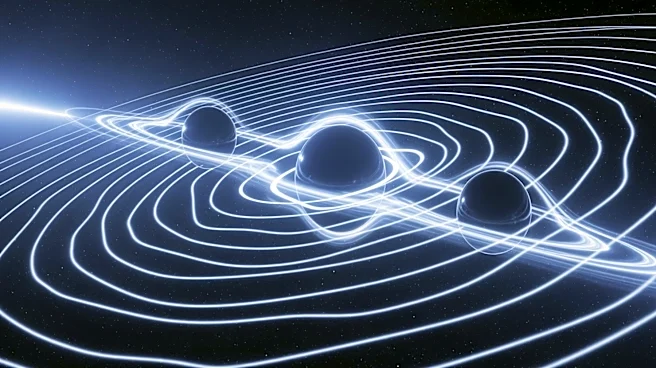
Astronomers have made a significant discovery by analyzing gravitational waves, revealing a 'lost world' of black hole mergers. This discovery, detailed in the Gravitational Wave Transient Catalogue-5.0 (GWTC-5), includes 161 new gravitational wave signals
detected by LIGO, Virgo, and KAGRA between April 2024 and January 2025. The catalog now totals 390 black hole mergers detected via gravitational waves. Highlights include 'second generation mergers' and the most precisely localized merger ever, which could help measure the universe's expansion rate. This discovery enhances our understanding of black hole formation and the universe's structure.
Why It's Important?
The discovery of new black hole mergers through gravitational waves is crucial for advancing our understanding of the universe. It provides insights into the formation and growth of black holes, which are key to understanding cosmic evolution. The ability to detect and analyze these mergers allows scientists to test theories of general relativity and measure the universe's expansion rate more accurately. This research could lead to breakthroughs in cosmology and physics, offering a deeper understanding of the universe's most violent events and the fundamental laws governing them.
What's Next?
The gravitational wave detectors LIGO, Virgo, and KAGRA are set to continue their observations, with a six-month intermediate observing run planned. This will bridge the gap between the end of Observing Run 4 and the start of Observing Run 5, scheduled for 2028-2031. These efforts are expected to yield more discoveries, further refining our understanding of black hole mergers and the universe's expansion. The ongoing research will likely continue to challenge and expand current cosmological models, contributing to a more comprehensive understanding of the universe.