







What's Happening?
The Interstate Bridge Replacement project, aimed at replacing the century-old Interstate 5 bridge between Portland, Oregon, and Vancouver, Washington, is encountering substantial funding hurdles, particularly for its light rail component. While federal
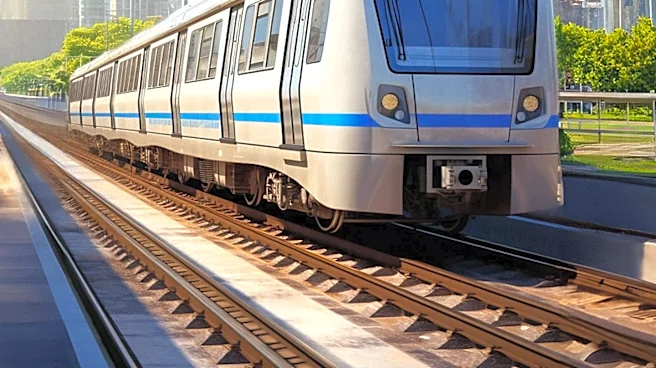
agencies approved a 1.9-mile extension of Portland’s MAX Yellow Line into Vancouver in July 2026, the project's estimated total cost ranges from $13.5 billion to $15.2 billion. Currently, only $5.69 billion is committed for the first phase, which only covers making the bridge 'light-rail-ready' and extending the line to the Vancouver Waterfront station, rather than the originally planned Evergreen Boulevard/Library Square. This means the light rail would terminate at an elevated station disconnected from downtown Vancouver. Additionally, an estimated $4.12 million for Washington's annual light rail operations and maintenance lacks a identified funding source. The current federal administration's focus on road projects over transit expansion further complicates the funding landscape.
Why It's Important?
The funding shortfall for the Interstate Bridge Replacement project's light rail extension has significant implications for regional transportation, economic development, and environmental goals. A truncated light rail line would diminish its effectiveness in connecting communities, providing access to jobs and commerce, and offering a viable alternative to driving. This could perpetuate traffic congestion, hinder efforts to reduce climate pollution, and limit economic opportunities for residents in both Portland and Vancouver. The project's history of political and economic challenges, including a failed replacement attempt in the mid-2010s, underscores the difficulty of securing comprehensive funding for large-scale infrastructure. The current situation highlights the critical need for sustained advocacy and innovative funding strategies to realize the full potential of this vital regional connection.
What's Next?
The project faces a critical period where sustained advocacy will be essential to close the funding gap and ensure the full light rail extension is realized. Local and state leaders, along with transit advocacy organizations, will need to intensify efforts to secure additional funding from federal, state, and local sources. Without a dedicated funding source for Washington's share of operational costs, the long-term viability of the light rail extension remains uncertain. The project's future may depend on shifts in federal transportation funding priorities or the development of new regional funding mechanisms. The ongoing construction of C-TRAN's Vine RapidRide system in Southwest Washington, which utilizes a mixed-funding approach, could offer a model for how transit agencies can deliver major capital projects without solely relying on massive federal packages.
Beyond the Headlines
The Interstate Bridge Replacement project's funding challenges reflect a broader national issue of underinvestment in public transit infrastructure, particularly in an era where climate change and urban congestion demand sustainable transportation solutions. The political and economic complexities surrounding such megaprojects often lead to compromises that can dilute their intended benefits, as seen with the potential for a disconnected light rail terminus. This situation also highlights the disparity in transit advocacy between regions, with Southwest Washington lacking a strong, unified voice compared to Portland. The outcome of this funding struggle will not only determine the future of a critical transportation link but also serve as a case study for how U.S. regions navigate complex infrastructure development, inter-state cooperation, and the pursuit of sustainable urban growth.