



What's Happening?
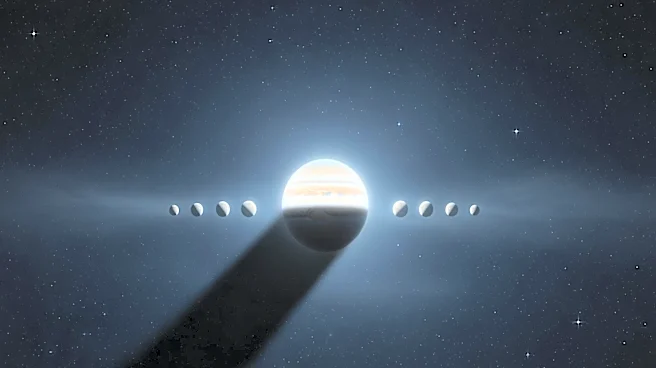
On the night of April 2, 2026, skywatchers in the United States have the opportunity to observe a celestial event involving Jupiter and its moons. Europa, one of Jupiter's Galilean moons, will pass north of Callisto, while Ganymede's shadow will transit
across Jupiter's cloud tops. This event is best viewed starting at 11 P.M. EDT, with Ganymede's shadow already in motion across the planet. The western half of the U.S. will have a better view as the shadow reaches Jupiter's western limb and disappears shortly after 1:22 A.M. EDT on April 3. Additionally, Mercury is visible in the early morning sky, reaching its greatest western elongation on April 3, providing a chance for early risers to spot it above the eastern horizon.
Why It's Important?
This astronomical event offers a unique opportunity for both amateur and professional astronomers to observe the dynamics of Jupiter's moons and their interactions with the planet. Such events are significant for educational purposes, allowing enthusiasts to learn more about the solar system's largest planet and its satellites. Observing these celestial phenomena can inspire interest in astronomy and science, potentially influencing educational and career paths. Moreover, these events contribute to ongoing scientific research and public engagement with space exploration.
What's Next?
Following this event, observers can look forward to improved visibility of Mars and Saturn in the morning sky as they rise to meet Mercury. These planetary alignments and movements provide ongoing opportunities for observation and study. The continued tracking of celestial events helps refine our understanding of planetary motions and enhances the accuracy of astronomical predictions.