



What's Happening?
The California Democratic Party is experiencing a leadership vacuum in the upcoming governor's race, as prominent figures like Governor Gavin Newsom and former House Speaker Nancy Pelosi have refrained from endorsing any candidate. Despite Representative
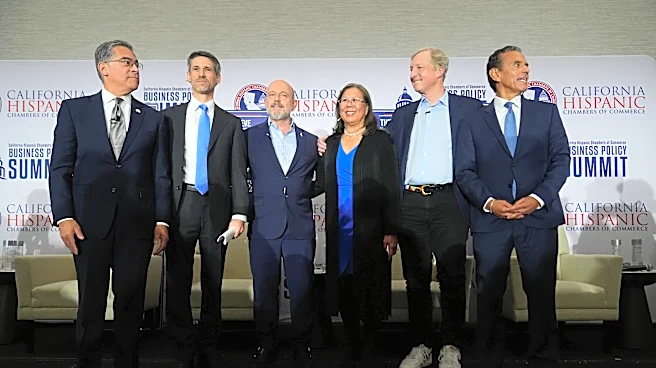
Eric Swalwell's recent withdrawal, the Democratic field remains crowded with seven major candidates, none of whom have emerged as a clear frontrunner. This situation is exacerbated by the state's top-two primary system, which allows the possibility of two candidates from the same party advancing to the general election. Party Chair Rusty Hicks has faced criticism for not taking a more active role in narrowing the field, relying instead on party-commissioned polls and urging candidates to assess their viability. The lack of a clear successor to Newsom, coupled with the absence of high-profile candidates like Kamala Harris and Alex Padilla, has left the party without a unifying figure to rally around.
Why It's Important?
The indecision within the California Democratic Party could have significant implications for the state's political landscape. The crowded field and lack of a clear leader increase the risk of a split vote, potentially allowing two Republican candidates to advance to the general election. This scenario is particularly concerning for Democrats, given California's history as a Democratic stronghold. The situation highlights the challenges of the top-two primary system and the potential consequences of a decentralized party leadership. The outcome of this race could influence the party's strategy and approach to future elections, as well as impact the broader political dynamics in California.
What's Next?
As the primary election approaches, the Democratic Party will need to navigate the complexities of a crowded field and the top-two primary system. Party Chair Rusty Hicks has indicated that ongoing polls will be conducted to gauge candidate viability, but it remains unclear if any decisive action will be taken to consolidate support behind a single candidate. The party's ability to unify and present a strong candidate could be crucial in maintaining its dominance in California politics. Additionally, the outcome of this race may prompt a reevaluation of the party's leadership structure and decision-making processes.