








What's Happening?
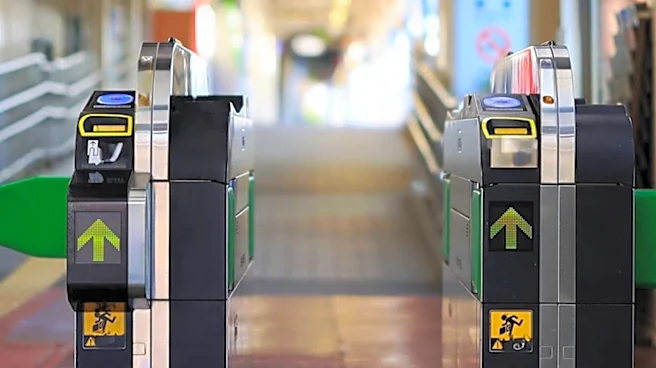
Sound Transit, a public transit agency in the Seattle metropolitan area, has approved an $87 million pilot program to install fare gates at fourteen light rail stations. This initiative aims to address significant fare evasion issues that have plagued
the system, particularly since the suspension of fare collection during the COVID-19 pandemic. In the mid-1990s, Sound Transit opted to design stations without turnstiles, relying instead on an honor system for fare payment to reduce construction costs and allow for barrier-free platforms. However, this decision led to substantial revenue losses, with 'non-revenue boardings' estimated at 44% in 2024, including students who ride free. Despite efforts to re-impose fares in 2023 and deploy 'fare ambassadors,' evasion remained rampant, costing the agency tens of millions of dollars annually. The pilot program is a direct response to these financial challenges, seeking to increase fare revenue by over $30 million per year.
Why It's Important?
This development is important for U.S. public transit agencies as it highlights the financial repercussions of fare evasion and the significant costs associated with retrofitting systems to enhance security and revenue collection. Sound Transit's original decision to forgo turnstiles, while initially cost-saving, has resulted in a substantial long-term financial burden. The estimated $87 million for the pilot program, coupled with ongoing monitoring and maintenance costs, underscores the expense of correcting past design choices. While the projected $30 million annual increase in revenue is a positive step, it represents a small fraction of the agency's $34.5 billion budget shortfall. This situation reflects a broader challenge for transit systems nationwide: balancing accessibility and operational efficiency with robust fare collection and financial sustainability. The outcome of Sound Transit's pilot program could influence other U.S. transit agencies grappling with similar issues, potentially leading to a re-evaluation of fare collection strategies and infrastructure investments.
What's Next?
The pilot program will proceed with the installation of fare gates at fourteen light rail stations. Sound Transit anticipates that these gates will contribute to an increase in fare revenue, aiming for over $30 million annually. However, the pilot project only covers a portion of the system's stations, meaning that fare evasion could still occur at the remaining 25 stations without gates. The agency will need to monitor the effectiveness of the gates in reducing evasion and assess the overall impact on ridership and revenue recovery. Further decisions regarding the expansion of fare gates to additional stations will likely depend on the success of this initial pilot. Additionally, Sound Transit faces the ongoing challenge of addressing its substantial budget shortfall and improving its farebox recovery rate, which has significantly declined from a target of 40% to 11% in 2024, with a revised target of 22%.
Beyond the Headlines
The Sound Transit situation reveals deeper implications regarding public trust, urban planning, and the evolving social contract of public services. The initial reliance on an 'honor system' for fare payment, while fostering a sense of community and reducing initial infrastructure costs, ultimately proved unsustainable in the face of widespread evasion. This raises questions about the balance between user convenience and financial accountability in public transit. The significant cost of retrofitting the system with fare gates highlights the long-term consequences of design decisions made decades ago. Furthermore, the agency's struggle to meet its farebox recovery targets, even with increased enforcement, points to a potential disconnect between public expectations for affordable transit and the financial realities of operating such a vast system. This scenario could prompt broader discussions about alternative funding models for public transit, the role of user responsibility, and the societal implications of fare evasion on the sustainability and equity of public services in urban environments.