
What's Happening?
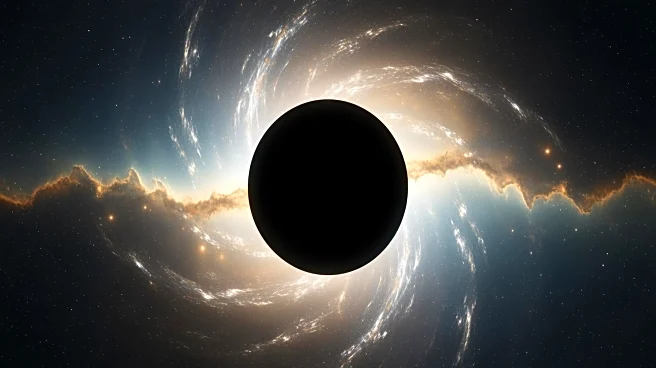
Astronomers have identified a massive cloud of vaporized metal that blocked the light from a distant star, J0705+0612, located about 3,000 light-years away. This cloud, which caused the star to dim significantly
for nine months, is believed to be gravitationally bound to a mystery object, possibly a massive planet or a low-mass star. The cloud, estimated to be 120 million miles wide, was observed using the Gemini South telescope and other facilities. The cloud's composition includes elements heavier than hydrogen and helium, such as iron and calcium, marking a rare observation of a circumplanetary or circumsecondary disk.
Why It's Important?
This discovery is significant as it provides insights into the dynamics of planetary systems and the interactions between stars and surrounding material. The presence of such a large cloud of vaporized metal suggests complex gravitational interactions and potential collisions in the system, which are rare in mature planetary systems. Understanding these phenomena can help astronomers learn more about the formation and evolution of planets and stars, as well as the conditions that lead to such dramatic events.
What's Next?
Further observations and analysis are needed to determine the exact nature of the mystery object holding the cloud together. Researchers will likely continue to study the system to understand the processes that led to the formation of the cloud and its implications for planetary system dynamics. This could involve more detailed spectroscopic studies to map the cloud's composition and motion, as well as simulations to model the gravitational interactions within the system.