
What's Happening?
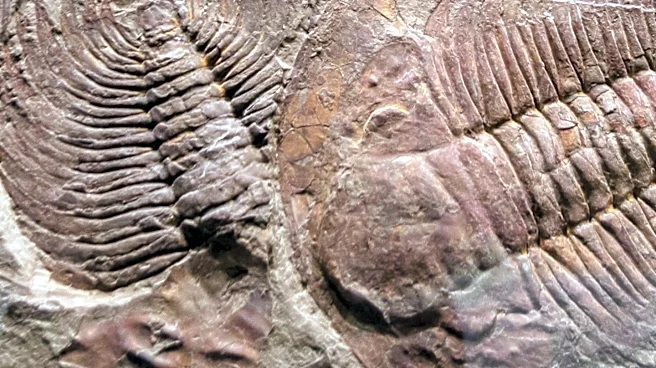
Waptia fieldensis, a Cambrian fossil from the Burgess Shale in British Columbia, Canada, has provided significant insights into early arthropod evolution. First described by Charles Doolittle Walcott in 1912,
this fossil is noted for its exceptional preservation, capturing fine anatomical details including soft tissues. Waptia fieldensis, which lived approximately 508 million years ago, is an early member of the arthropod lineage, showcasing differentiated appendages, a flexible carapace, and evidence of brooding behavior. These features bridge the evolutionary gap between early Cambrian stem-arthropods and later crustacean groups. The fossil measures around 4-8 cm in length and features a bivalved carapace, a fan-shaped tail, and large compound eyes, indicating a predatory or scavenging lifestyle.
Why It's Important?
The discovery of Waptia fieldensis is crucial for understanding the evolution of arthropods, a group that includes insects, crustaceans, and other mandible-bearing animals. The fossil's anatomy reveals several evolutionary innovations such as true mandibles, differentiated head appendages, and flexible biramous limbs, which are significant for both swimming and feeding. The presence of eggs beneath the carapace provides one of the earliest pieces of evidence for parental care in the fossil record, highlighting advanced reproductive strategies. This discovery underscores the complexity of Cambrian ecosystems and the early establishment of traits that would lead to the success of arthropods.
What's Next?
Further research on Waptia fieldensis and similar fossils could provide deeper insights into the evolutionary pathways of arthropods. Paleontologists may continue to explore the Burgess Shale and other Cambrian deposits to uncover more specimens that could fill gaps in the understanding of early arthropod diversification. These studies could also refine the timeline of when specific evolutionary traits emerged, offering a clearer picture of the Cambrian explosion and its impact on modern biodiversity.
Beyond the Headlines
The discovery of Waptia fieldensis not only enriches the understanding of arthropod evolution but also raises questions about the ecological dynamics of Cambrian seas. The fossil's advanced features suggest that complex behaviors and ecological roles were already present in early marine ecosystems. This challenges previous assumptions about the simplicity of early life forms and highlights the rapid pace of evolutionary innovation during the Cambrian period.