





What's Happening?
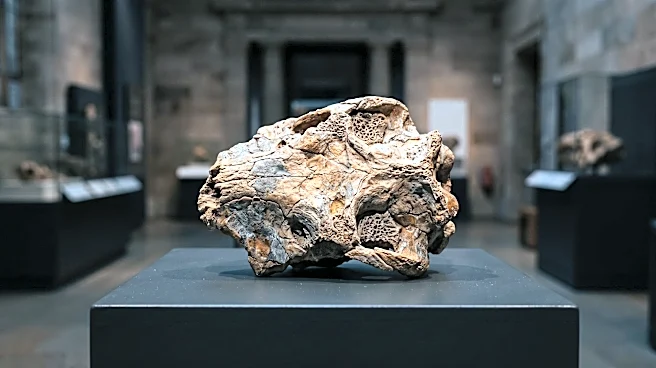
Fossils unearthed in China between 1976 and 1979 have been identified as belonging to Denisovans, a mysterious group of ancient humans. A research team led by Qiaomei Fu of the Chinese Academy of Sciences used advanced paleoproteomics to analyze a skull
and jaw fragment from the Xujiayao archaeological site. They isolated 18 distinct ancient proteins, including a specific collagen variant, COL1A2-996K, which is unique to Denisovans and absent in Neanderthals and modern humans. This molecular identification confirms the Denisovan lineage of these fossils. The study, published in the journal Nature, provides the first clear insight into the physical appearance of Denisovans, who existed approximately 300,000 to 45,000 years ago. The reconstructions show Denisovans had thick, robust cranial bones, a low and relatively flat skull, and pronounced brow ridges, combining ancestral hominin features with traits seen in Neanderthals and other archaic human groups.
Why It's Important?
This discovery significantly expands the understanding of human history by confirming that Denisovans were not confined to high-altitude Tibetan regions or remote Siberian caves. Instead, the findings suggest a much broader and more diverse population that thrived across East Asia. This re-evaluation of the Denisovan geographical range could lead to the reclassification of numerous other fossils previously found in the region, fundamentally altering the map of hominin dispersal. The use of paleoproteomics represents a significant advancement in paleoanthropology, offering a new method for identifying ancient human remains when DNA is not well-preserved. This breakthrough provides crucial morphological data for a group previously known primarily through genetic evidence, offering a more complete picture of human evolution and the diversity of archaic human populations in Asia.
What's Next?
The identification of these fossils as Denisovan opens new avenues for research into other unidentified or misclassified ancient human remains in East Asia. Researchers will likely re-examine existing fossil collections from the region, applying similar paleoproteomic techniques to determine if more specimens belong to the Denisovan lineage. This could lead to a more comprehensive understanding of Denisovan morphology, genetic diversity, and their interactions with other hominin groups, including early modern humans and Neanderthals. Further studies may also focus on the environmental and cultural contexts in which these East Asian Denisovans lived, providing insights into their adaptations and behaviors across a wider geographical area than previously thought.
Beyond the Headlines
The identification of the Xujiayao fossils as Denisovan highlights the ongoing re-evaluation of human evolutionary narratives, particularly in Asia. For decades, the sparse fossil record of Denisovans meant their physical characteristics were largely unknown, making them a 'ghost lineage' identified primarily through genetics. This discovery provides tangible physical evidence, bridging the gap between genetic and morphological data. It underscores the complexity of human evolution, suggesting multiple archaic human groups coexisted and potentially interbred across vast regions. The findings challenge previous assumptions about hominin migration patterns and population distributions, emphasizing the need for continued interdisciplinary research combining genetics, proteomics, and traditional paleoanthropology to unravel the full story of human origins.