



What's Happening?
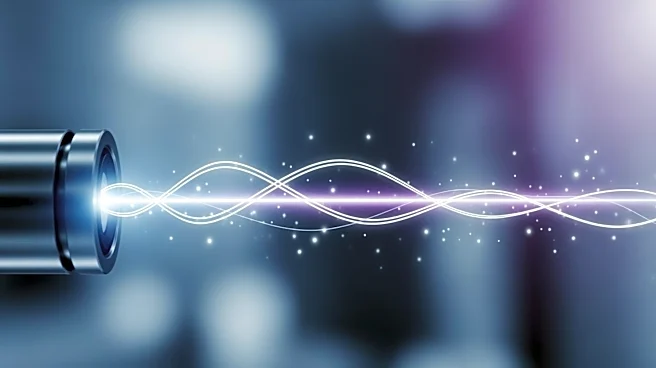
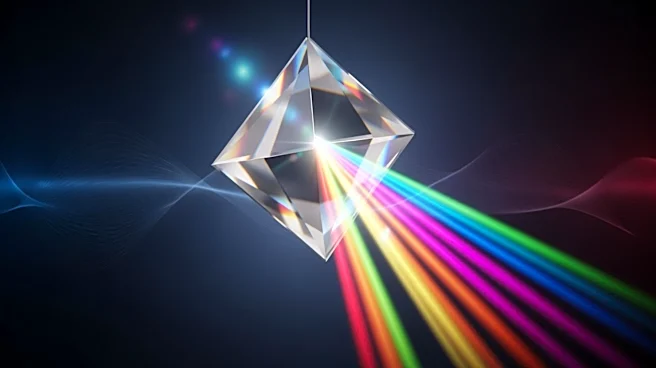
Researchers at the University of East Anglia have discovered a new property of light that allows it to twist and spin without the need for mirrors or special lenses. This breakthrough reveals that light can develop chiral behavior, acting like a left
or right hand, while traveling through space. The discovery could revolutionize medical testing, data transmission, and quantum technologies by enabling light to carry information and manipulate matter. The research, published in the journal Light: Science & Applications, shows that light can be programmed by exploiting its natural geometry, offering a new way to control light using its topology.
Why It's Important?
This discovery has significant implications for various fields, including medicine, communications, and quantum technology. By enabling light to naturally exhibit chiral behavior, the research could lead to simpler and more sensitive medical tests, particularly in drug development. In communications, the ability to pack more information into light beams could enhance data capacity and security, benefiting industries reliant on high-speed data transmission. The findings also suggest potential advancements in quantum technologies, where light's internal geometry could protect delicate quantum information from noise and disruption. Overall, this research could pave the way for a new generation of light-based technologies.
What's Next?
The next steps involve exploring practical applications of this discovery in real-world technologies. Researchers may focus on developing compact optical sensors and communication technologies that leverage the newfound properties of light. The potential for simpler medical tests and more robust quantum technologies could lead to collaborations with industries seeking to integrate these advancements into their products. As the scientific community further investigates the implications of this research, it may inspire new innovations and applications across various sectors, ultimately transforming how light is used in technology.