



What's Happening?
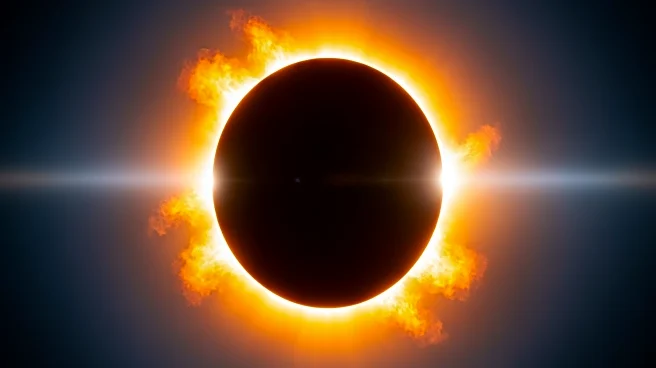
A rare annular solar eclipse is set to occur on February 17, 2026, primarily visible from Antarctica. During this event, the Moon will cover the Sun partially, creating a 'ring of fire' effect. Observers in southern South America and southern Africa will witness
a partial eclipse, while the rest of the world, including India, will not see the eclipse. The eclipse will begin over the Antarctic mainland and move across the Davis Sea. The 'ring of fire' will last up to 2 minutes and 20 seconds, with Concordia Station in Antarctica being a prime viewing location. The event will be followed by a total solar eclipse in August 2026, visible in parts of Europe and North America.
Why It's Important?
This celestial event highlights the unique astronomical phenomena that occur on Earth, offering opportunities for scientific observation and public interest in astronomy. While the eclipse will not be visible in India, it underscores the global nature of such events and the importance of international collaboration in scientific research. The eclipse also serves as a reminder of the need for proper safety measures when observing solar events, as looking directly at the Sun can cause eye damage.
What's Next?
Following the annular solar eclipse, a total solar eclipse is expected in August 2026, visible in Greenland, Iceland, Spain, Russia, and parts of Portugal. This upcoming event will provide further opportunities for scientific study and public engagement with astronomy. Observatories and research stations in the path of the eclipse will likely prepare for detailed observations and data collection.