
What's Happening?
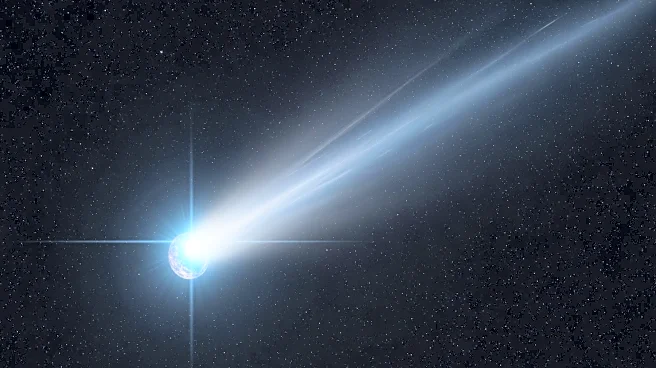
On December 13, 2025, Comet 3I/ATLAS, the third confirmed interstellar object to enter our solar system, is drawing significant attention from astronomers. Recent observations have revealed a bright green
glow and the first X-ray views of the comet. The green hue is attributed to gases released as the comet heats up near the Sun, while X-ray emissions are linked to interactions with the solar wind. The comet is set to make its closest approach to Earth on December 19, 2025, at a safe distance of approximately 270 million kilometers. This event presents a unique opportunity for scientists to study an interstellar object and gain insights into the formation of other star systems.
Why It's Important?
The study of Comet 3I/ATLAS is significant as it provides a rare opportunity to analyze material from outside our solar system. Understanding the composition and behavior of interstellar comets can offer valuable information about the conditions and processes in other planetary systems. The comet's green glow and X-ray emissions are of particular interest, as they may reveal new chemical interactions and the presence of elements not commonly observed in solar system comets. This research could enhance our knowledge of cometary science and contribute to broader astronomical studies.
What's Next?
As Comet 3I/ATLAS approaches its closest point to Earth, astronomers will continue to monitor its behavior and gather data. The focus will be on analyzing the comet's composition and the changes in its emissions as it interacts with the solar environment. This ongoing research will help refine models of interstellar objects and improve our understanding of their origins and trajectories. The findings from this study may also inform future missions and observational strategies for detecting and analyzing similar objects.