









What's Happening?
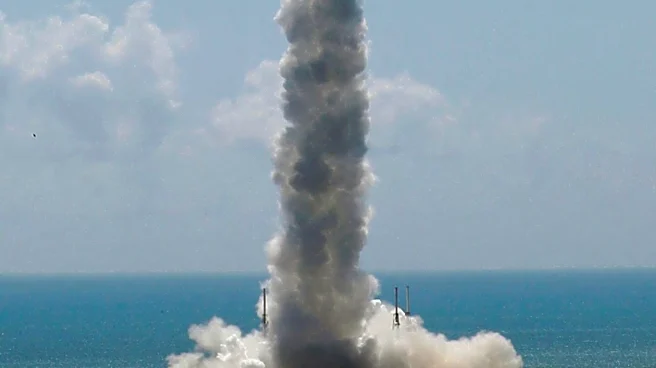
China's military conducted a test-launch of a long-range ballistic missile from a nuclear-powered submarine in the South Pacific, drawing protests from regional countries. The missile, carrying a dummy warhead, was launched as part of routine annual training,
according to China's official Xinhua News Agency. This test follows a similar launch two years ago and is seen as an assertion of China's growing military capabilities. The launch has been criticized by Australia, Japan, and New Zealand, with concerns about the missile flying over Japan and the potential security risks it poses. The test occurred in the South Pacific Nuclear Free Zone, established by the 1986 Treaty of Rarotonga, which China ratified in 1987, agreeing not to test nuclear weapons in the region.
Why It's Important?
The missile test underscores China's expanding military influence and its potential impact on regional stability. The test has heightened tensions among Pacific nations, who view such actions as destabilizing. China's growing military capabilities, including its fleet of ballistic-missile submarines, are seen as a challenge to the existing balance of power in the region. The test also raises questions about China's adherence to international agreements, such as the Treaty of Rarotonga, and its commitment to regional peace. The reactions from Australia, Japan, and New Zealand highlight the geopolitical implications of China's military activities and the need for diplomatic engagement to address security concerns.
What's Next?
The test is likely to prompt further diplomatic discussions among Pacific nations and with China to address the security concerns raised. Countries in the region may seek assurances from China regarding its future military activities and adherence to international agreements. The test could also influence regional defense strategies, with countries potentially increasing their military readiness in response to perceived threats. Additionally, the test may impact China's relations with other major powers, such as the United States, as they monitor China's military developments and their implications for global security.